It’s Marty Supreme, It’s Marty Supreme: A Review of Marty Supreme
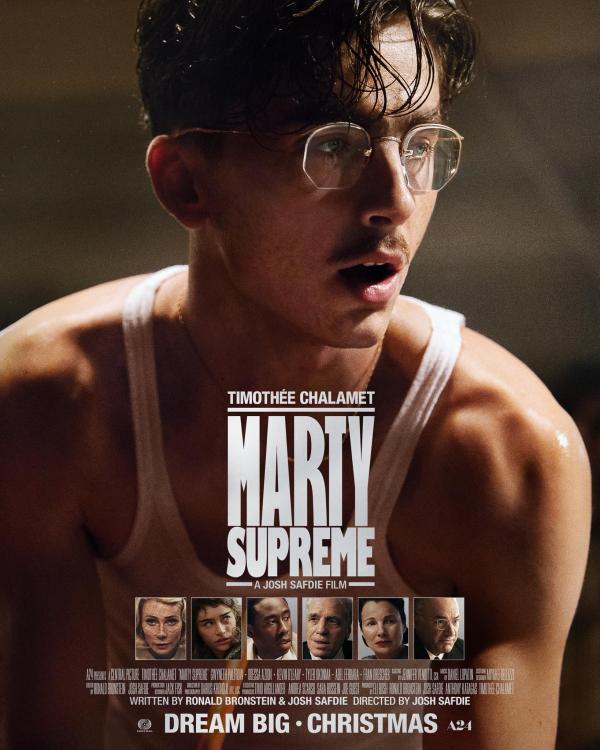
The press tour for Josh Safdie’s new film, Marty Supreme, is virtually inescapable. Perhaps you’ve seen the orange blimp flying over the southern USA. Or the viral colour-block windbreaker worn by a motley list of celebrities ranging from Patti LuPone to Bill Nye to Frank Ocean. Or star Timothée Chalamet rapping a verse on EsDeeKid’s “4 Raws”, which is my personal favourite of the film’s idiosyncratic promotional stunts. Underscoring this marketing extravaganza is Chalamet’s insistence on his own excellence. With his declared ambition to be considered “one of the greats,” Chalamet sets a high bar for his performance—a bar which he extraordinarily exceeds, cementing his status as a generational talent.
Marty Supreme follows Jewish-American Marty Mauser (Timothée Chalamet) as he endeavours to prove to the world what he unwaveringly believes about himself: that he is the greatest ping pong player ever. The film begins with Marty as a silver-tongued shoe salesman working for his uncle Murray (Larry ‘Ratso’ Sloman), and his first lines spoken are lies to a customer about shoe size. Enter Rachel Mizler (Odessa A’Zion), the fiery married woman with whom he is engaged in an affair. After the two have sex in the shoe store’s stockroom, an inspired opening credit sequence plays, during which Rachel’s freshly fertilized ovum transforms into a ping pong ball. The film’s first act sees Marty rob the shoe store at gunpoint to retrieve $700 (which, to be fair, he is owed) and fly off to compete in the British Open. Marty beats the reigning champion, Hungarian Holocaust survivor Bela Kletzki (Géza Röhrig), but is ultimately defeated in the finals by the deaf Japanese newcomer Endo (played by Koto Kawaguchi, who is also a deaf table tennis player in real life). Broke and humiliated, Marty tours with the Harlem Globetrotters as a farcical sideshow act in order to scrounge together enough money for transportation to the next year’s table tennis championship in Tokyo.
What follows is an odyssey at breakneck speed: Marty runs from the police after his uncle has him arrested, Marty learns Rachel is pregnant with his child, Marty owes $1500 to the International Table Tennis Association, Marty accidentally gets involved with mobster Ezra Mishkin (Abel Ferrara), Marty hustles with cab driver Wally (Tyler Okonma, AKA Tyler, the Creator), Marty begins an affair with former movie star Kay Stone (Gwyneth Paltrow), Marty is abjectly degraded by Stone’s megalomaniac husband Milton Rockwell (Kevin O’Leary), Marty repeatedly devolves himself into deeper and deeper debt. Josh Safdie co-edited the film with longtime collaborator Ronald Bronstein, and the result is electric, gripping audiences from the very first shot and leaving no time for respite. At every turn, audiences don’t know what to expect; the only certainty is Marty’s unyielding conviction of his destiny, and his willingness to exploit and sacrifice anyone and anything to realize it. As he says in one scene, when Kay Stone asks him what he plans to do if his dream doesn’t work out: “That doesn’t even enter my consciousness.”
Safdie and Bronstein also co-wrote the film and created the character of Marty Mauser for Chalamet specifically. While Marty Supreme is ultimately Chalamet’s show, his performance is thrillingly matched by Odessa A’Zion, who plays Rachel with such ferocity that scenes between the two are nothing short of exhilarating. Gwyneth Paltrow is masterful as Kay Stone, conveying her character’s underlying need for love with a steady confidence. Aided by his persona as a ruthless investor on Shark Tank, Kevin O’Leary’s performance as Milton Rockwell is bone-chilling. The film’s soundtrack is replete with songs from the 1980s, reflecting Marty’s fixation on his future grandiosity, his conviction that he is miles ahead of those around him, and his refusal to occupy himself with past or present happenings.
Set in 1953, just eight years after the Holocaust, Marty Supreme is fundamentally a secular Jewish story about chasing assimilation in a society that continues to sideline you. Marty imbues himself with a messianic purpose, driven by a pathological need to vindicate the Jewish people from their perceived weakness following the Holocaust. He calls himself “Hitler’s worst nightmare.” He gifts his mother (Fran Drescher) a piece of an Egyptian pyramid that he hacked off while touring with the Harlem Globetrotters and forcefully proclaims: “We built that.” The weight of six million dead Jews propels his dogged determination to prove himself, not only as the greatest ping pong player in the world, but as a beacon of American exceptionalism.
What makes the film’s tagline, “Made in America” so poignant is that Marty’s brash conviction of his primordial superiority is what makes him so American after all.
Marty Supreme is currently playing in cinemas.



Staff Login | Advertise | Our Location | RSS | Contact Us
