RSS
January 30th 2012
Produced By Melissa Mulligan
Read By Sarah Deshaies
Articles By Gregory Wilson, Esther Viragh, Audrey Folliot, Sarah Deshaies, Sofia Gay & Daniel J. Rowe
Canadian law prevails
 The Shafia trial is finally over.
According to the CBC, Mohammad Shafia, his wife Tooba Yahya and their son Hamed were all convicted Sunday of first-degree murder.
They were accused of killing Shafia’s three daughters and his first wife in a polygamous marriage.
The bodies of the four drowned women were found in a car at the bottom of the Kingston Mills lock.
They have been sentenced to life imprisonment with no chance of parole for 25 years.
The trial took almost three months to complete and the verdict came after only 15 hours of deliberations.
The three individuals maintained their innocence until the very end. The son’s lawyer told The Canadian Press his client would appeal the ruling.
Afghan President Karzai coming negotiations with the Taliban
 Afghan President Hamid Karzai is planning to meet with the Taliban in Saudi Arabia to engage in peace talks, according to the BBC.
The meeting is scheduled to happen in the coming weeks, before the Taliban office gets erected in Qatar. The Taliban however notified they will only speak with the United-States and other allies of the Afghan government.
Karzai said he was frustrated that the US and Qatar have previously started working on peace treaties with the Taliban without the Afghan government’s full presence.
There are rumors that the coming discussions might revolve around a prisoners exchange between the Taliban and the United-States.
PQ to lower the voting age if elected
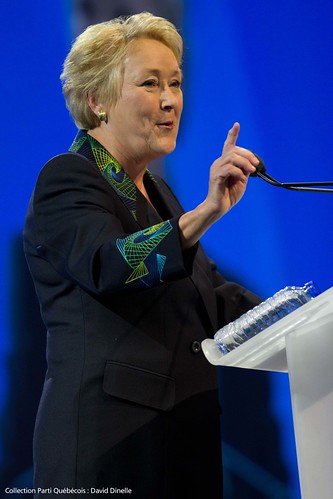 If elected to government, the Parti Québecois plans to lower the voting age to sixteen years old.
The PQ also plans to adopt citizen-led referendums in Quebec.
These are just two of a series of plans adopted by the delegates of the provincial opposition party at this weekend’s meeting in Montreal.
The young are among the strongest supporters of the PQ’s sovereignty movement.
The proposal of the citizen-led referendum means that there could be a referendum if fifteen percent of the population was to vote for one on any topic.
This also goes for future referendums on Quebec’s independence.
Pauline Marois is now the official PQ leader after weeks of rumors that former Bloc Quebecois leader Gilles Duceppe might replace her.
Duceppe has announced last week that he was not going to return to active politics after he was accused of mishandling public funds.
The PQ is still third in the polls, not far behind the Liberals, while the CAQ is still leading the polls.
Domain names with French characters to be allowed in Canada
 It seems like the internet will become more friendly to francophones. The Canadian Press reports domain names ending in .ca might allow French letters with accents.
A consultation by the Canadian Internet Registration Authority went into its final step last week. They say this change is part of a global movement. Other alphabets have already been approved.
French letters with accents might be approved in nine to eighteen months. France already finished its consultation and will allow letters with accents soon.
Igloofest: Week 2 Recap

After a hot first weekend that provided us with awesome acts like Buraka Som Sistema, A-Trak and Mala, it was going to be hard for the second weekend to top it, but it did, in a big way. On Saturday night, more then 10 000 fans flocked to the site in the Old Port, making it the first ever sold-out night in the history of Igloofest. The stellar lineup may have helped them reach such an achievement. The three days featured big names like Tiga, Pearson Sound, Sébastien Léger, Terence Fixmer, and Max Cooper, all guaranteed to make the fans dance all weekend long.
Friday, January 20th
Friday night got started with the sounds of Seb Fauteux and Max Reynolds who played a groovy set. The duo mixed an upbeat and well-balanced blend of house, techno and some disco, an excellent recipe for a cold night where temperatures hovered around -15°C. You can catch them at the Fizz Factory and Beat Boutique nights at Le Salon Daome on Mount-Royal Boulevard.
They were followed up by the brilliant UK DJ/Producer and Hessle Audio head honcho, David Kennedy, aka Pearson Sound, who was playing in front of a Montreal crowd for the second time in a year. He played a nice set with loads of great tracks, but it felt as if he was holding back and his set never really peaked; considering the immense talent that he’s blessed with, his set never really reached it’s full potential. Luckily, German DJ D. Diggler saved the night by continuing along the same pace as Seb Fauteux and Max Reynolds, making the 9000 plus fans dance the cold winter chill away. I didn’t know what to expect from Diggler, but he turned out to be a pleasant discover. I’m looking forward to hearing more from him.
That same night, I discovered the sounds of electro-swing music being played in the Virgin Mobile Igloo for the first time. Electro-swing is the merging of 1930’s swing music with bass heavy electro songs, making it a very enjoyable and interesting new genre to discover. DJ’s Khalil, Eliazar, Don Mescal (all part of the Speakeasy Electro Swing nights) got the Igloo packed –there was a big line up just to get in.
Saturday, January 21st
Hakim Guelmi opened the Saturday night edition with his own blend of techno and tech-house. He is a regular of Piknic Electronik, Igloofest’s summer counterpart, so you may have heard him before. Last summer, Max Cooper got stuck in the wake of Hurricane Irene and unfortunately had to cancel his Piknic Electronic show. Fast forward five months later; he now gets the chance to perform for the Montreal crowd at Igloofest. The UK DJ brought an assortment of techno and house beats that kept people dancing throughout the set. He was certainly one of my favourite DJs of this year’s edition. But Saturday night was Sébastien Léger’s nights. The French DJ was highly anticipated. Léger’s Chicago/Detroit inspired house got the crowd so worked up that I think he even trended on Twitter at one point. On stage, you could see his energy, as he danced along while mixing his tracks.
It was a great way to end the second weekend of Igloofest, and the last one promises to be a record breaker as well. If you missed this past weekend, I feel sorry for you, but you better not miss the third one.
News - January 27th 2012
Read by Shaun Malley
Produced by Erica Bridgeman
Stories read by Chris Hanna, Judy-Ann Mitchell-Turgeon and Tara Brockwell
Canada seizes a piece of Tunisia's pre-revolutionary pie
The federal government is set to cash-in on the spoils of Tunisia’s pre-revolutionary regime.
According to the CBC assets of members tied to Tunisia’s deposed dictator in Canada were seized. This includes the Westmount home of former dictator Zine El Abedine Ben-Ali’s billionaire son-in-law who has since fled to Qatar.
A lawyer for Tunisia’s current government claims Canada plans to keep fifty per cent of the spoils. This enraged local Tunisian community groups who want funds returned to a nation they believe was plundered.
An E-mail from the Department of Foreign Affairs to the CBC stated that funds could be kept for up to five years while an agreement is drawn up with the new Tunisian government.
Details about numbers were not revealed.
The impact of AIDS on Aboriginal people
Yesterday was the third lecture of Concordia University’s Community Lecture Series on HIV/AIDS.
As Doris Peltier delivered her moving story, the audience sat still, absorbing every word of it.
Back in 2002, this Aboriginal woman from the Wikwemikong Unceded First Nations reserve in Ontario was diagnosed with AIDS.
After a difficult childhood of losses and abuse, she decided that she wouldn’t let the disease overcome her.
Ever since she received her diagnosis, she has been working as an activist for the Canadian Aboriginal AIDS Network at the local, national and international level.
She has been giving conferences to share her experience and give hope to those suffering from the same disease.
“I did not want to just be another statistic, I decided to step out and start speaking about it, and disclose my HIV status publicly because we NEED to talk about it.”
As an activist, Doris Peltier is also involved in research with the Canadian Aboriginal AIDS Network.
Statistics show that Aboriginal women represent 48.8 percent of the HIV infection rate in the community, while youth represent around 32 percent.
For the most part, this epidemic comes from the colonization of the Aboriginal communities by the Europeans back in 1492.
At the time, Aboriginal children were taken from their parents and forced to attend residential schools in an attempt to assimilate them and turn them into westerners.
All of this caused severe disorganization in indigenous societies and disrupted their traditional social structures, alliances and kinship ties.
What Doris Peltier also focuses on are ways of decolonizing the Aboriginal communities in order for them to finally heal, mostly through healing circles.
“Part of the decolonizing is about telling our stories, it validates our experience and it helps to make sense of the past, it’s about releasing something, it’s about removing layer upon layer, and once you begin removing those layers, you began to discover some strengths that might have been covered up by those layers.”
For Peltier, speaking is part of her healing process, and it is part of accepting the disease and becoming the woman she is today.
She insisted on the importance of talking about HIV and AIDS, because healing won’t work in isolation.
“For me, what happened when I was diagnosed was for the very first time I was able to say NO. I experienced childhood sexual abuse, and as a child, you know, you’re frightened, it shuts you down and you’re not able to say no, but for the first time I was able to say no when I got my AIDS diagnosis, no more, no more!”
For many years, Aboriginal women lived with self-esteem issues that made them vulnerable to HIV and AIDS.
The title of this conference was an aboriginal word that meant “the essence of who we are is beautiful”.
And after sitting through the moving and inspiring speech that Peltier delivered, I knew that she was right.
Audrey Folliot, CJLO News
US military will decrease troops
 The US plans to take 100,000 troops out of their military force.
According to BBC News, US Defence Secretary Leon Panetta stated that his plan is for the sake of creating a smaller military.
Panetta also revealed military cuts which will be made, such as the retiring of old cargo planes and Navy cruisers.
Republican presidential candidates feel that these plans are not good for the country and will argue against it throughout election time.
Pages



Staff Login | Advertise | Our Location | RSS | Contact Us
