RSS
ANDREW DOMINIK’S BLONDE: A CRITICAL REVIEW
CW: This article talks about sexual assault present in the film.
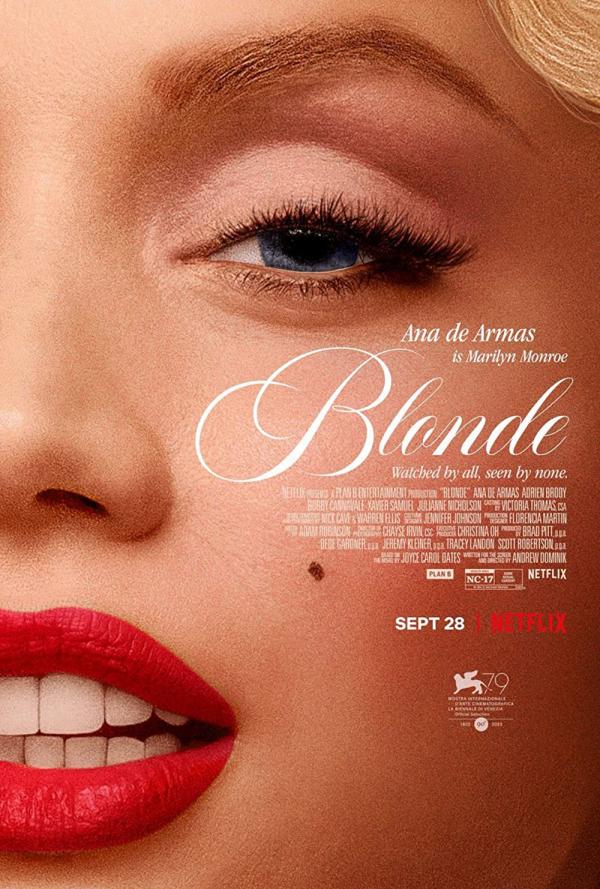
Existing in the spotlight is very complicated and complex; even now, it is rare to come out unscathed—both in the public’s eye and in your own. This, if nothing else, is clear throughout Andrew Dominik’s Blonde (2022), the newly released Netflix film calling itself a fictional portrait of Marilyn Monroe and “the price she paid for fame.”
Based on the critically acclaimed novel by Joyce Carol Oates, Blonde opens with Marilyn Monroe as a young Norma Jeane (Lily Fisher) constantly tormented by her mother Gladys (Julianne Nicholson), who believes Norma to be a child ‘accursed’. After Gladys tries to drown her in a scalding bath, Norma escapes to a nearby neighbour, at which point she is sent to an orphanage, and her mother is indefinitely institutionalized. Andrew Dominik juxtaposes two shots: the young Norma crying, and an older Marilyn (Ana de Amas) displayed, smiling, in an array of nude photos. This is followed almost immediately by her audition in front of a Hollywood mogul, which quickly turns into a rape scene. We watch as she lands roles and becomes successful, not based on talent, but on a combination of that first audition (her “start” in the business) and her heavy sex appeal. She struggles with, in Dominik’s words, wanting to “destroy her life,” navigating several relationships despite this—a long threesome with Charlie Chaplin Jr. and Edward G. Robinson Jr., two marriages, and a secret relationship with J.F.K, all before her suicide at the age of 36.
Blonde presents us with three unyielding, relentless truths about this version of Marilyn. First, that she is wholly and irredeemably fatherless, looking everywhere and never being wanted by him. Second, that, to undo the lack of love she received in her childhood, she is desperately and unsuccessfully trying to “give birth to herself [anew]” by having a child of her own; and third, that Marilyn Monroe is a character Norma Jeane puts on, at the advice of her male-led team: a ‘sexpot’ she is ashamed of, a ‘dirty slut’ she does not feel connected to—who prioritizes fame and money over Norma’s driving wish for a family, and can only be coaxed out through a combination of drugs and managerial pressure.
Blonde is shot and scored well, if not sometimes heavy-handed and on-the-nose, which succeeds only in making it an aesthetic exploitation. The only two women with speaking roles who remain clothed are Marilyn’s childhood neighbour and the lady putting on her shapewear, both portrayed as helpful, contained, non-sexual maternal figures. If a woman in Blonde is enraged, in distress, abusive or abused—and, constantly tear-streaked, they almost always are—they are also at least partially naked. Marilyn herself is almost never shown happy, except for when she is fulfilling a man’s sexual or romantic fantasy, basking in the glow of male validation she never received from her father: calling her husbands ‘Daddy’ or asking if she is a good girl for finishing her mashed potatoes. All sexual scenes (which only happen outside of Marilyn’s marriages) are drawn-out and explicit, including her assaults; her audition rape is shown in detail, twice, and her coerced, forceful blowjob to J.F.K is painfully long and narrated, heavily alluding to a second rape once she passes out.
Even when the sex is consensual (which only happens in the imaginary, often public, threesome), Dominik mirrors Marilyn’s face as she orgasms with her face as she is choked on film: a transparent reference to the tired, debunked notion that women experiencing climax look identical to women experiencing pain. This is one example of a larger problem: given the chance to imagine any alternative universe, Dominik chooses one where Marilyn Monroe had it even worse, time and time again. Similarly, though the film touches on Marilyn’s real miscarriages, her hopeless desire for a child is shown mainly through the fictitious addition of a forced abortion, where we see the inside view of Marilyn’s vagina being opened by a speculum and, later, hear a second fetus (pictured as a fully grown CGI baby, floating around in utero) asking, in a young girl’s voice, not to be discarded like the first.
One of the main producers of Blonde, a movie at least partly about Marilyn’s physical and emotional abuse, is Brad Pitt—recently accused of being a physical and emotional abuser. Whether Pitt also agrees with Dominik—that Marilyn played the part of a “well-dressed whore,” or “had to be a little baby [to be a sex symbol]”—is up for debate. There is, however, an obvious disconnect between how Dominik views his film, and how many film watchers have expressed they do; most notably, he describes a single “almost glossed over” rape scene and claims he does not see the film as anti-abortionist. After all, he wrote the film before Roe v Wade (when people began caring about abortion) to the standards of the 1950s (when fetuses used to resemble 9-month-old babies, shrouded in light).
The events the movie omits, those it keeps, and those it adds, are all very telling. Though she references dead Russian novelists to the men she wants to impress, Marilyn is infantilized to the point of being surprised Italian people make spaghetti. Gone is everything that makes Marilyn a woman who did not live entirely for, through, and because of the men around her: her female friendships, her production company, her vocal opposition of both the 1950s House Un-American Activities Committee and African American segregation, her immense talent, wit and intelligence. In his interview with Sight and Sound, Dominik admits that this would have required “looking at it through a lens that’s not so interesting to [him].” We can gather quite easily what is interesting to him: all factual scenes of physical abuse on an adult but child-like, shirtless Marilyn; and all fictitious scenes of sexual abuse, exploitation and pre-marital dalliances of (again) an adult but child-like, shirtless Marilyn. Gone, too, is everything but the bare minimum needed for Marilyn’s childhood backstory—perhaps because, although tragic, the scenes cannot be played by a topless Ana de Amas.
The resulting character is not complex, or multi-faceted; instead, as she is presented, interwoven between real events and iconic images, it is hard to imagine the real Marilyn as more than an overwhelmed pawn, a blow-up doll brought to life and told to balance Madonna and Child with Madonna and Whore. In the end, the film comes off as Andrew Dominik’s 3-hour “rescue fantasy,” portrayed through misery porn. But, in Dominik’s own words, “Why would [that] matter? It’s just a movie about Marilyn Monroe.”
In the face of Marilyn’s filmography, her cultural impact, and her legacy, now 60 years in the making, he’s right—Blonde doesn’t matter; it fails wholly to offer any insightful, important perspective, or even to contribute anything new to the conversation.
Gulfer + Deanna Petcoff + PACKS + Jaywood's Playful Performances for This Year’s POP Montreal Music Festival
As we swung into October, crisp weather, colourful trees, and the POP Montreal Music Festival reappeared to remind us of the everchanging seasons. More than 400 local and overseas artists and bands gathered at over 50 venues around the Mile End area and across the city for another glorious week of live music to raise the chilly spirits.
September 30 marks day three of performances of the six day-long festival. Lined up for that evening’s live performance was Gulfer, Deanna Petcoff, Packs, and Jaywood. Center stage at Casa del Popolo on St Laurent, right at the heart of Mile End, a handful of millennials were gathered eagerly awaiting another highly anticipated low maintenance live show.
Upon first glance, the venue seemed like a regular bar: lights dimmed just enough to obscure far-sightedness to a matter of a squint. A bar filled with overpriced alcoholic drinks was accompanied by a lonely DJ spinning in solitary contentment at the back. Only upon approaching the farther corner of the venue, would one have been able to discover the door: the secret gateway to the real live band music experience.
The scene is set: four fly looking lads stunting under silver-studded ceilings and rich red lights. Jaywood, lead by Winnipeg’s Jeremy Haywood Smith, took the lead on the night's musical adventure. Their jazz-y twist on indie music is reminiscent of sixties psychedelic music and takes the crowd on a trip. Thick bass notes solidify the roots of each song. Sly synth riffs slip in between guitar licks, creating a solid trunk that holds the branches of each melody and expanding into the sky. The chemistry of the group is clear as the sound comes together naturally. Their impressive manipulation of melodies brought to mind a timelapse video of a planted seed growing into a fully bloomed flower.
Toronto’s Packs plays next and their somewhat forgettable performance turns the tables on the phrase, “first is worst and second is best.” Not to be taken to the extreme, their set was pleasant to listen to, but their regular rock style of music was more reminiscent of a restaurant’s background playlist, rather than a live show. Their artistic abilities have definite potential though, especially in combination with additional original inspirations.
The audience’s awesome spirit was awakened again as Toronto-based singer-songwriter Deanna Petcoff took up the mic. Her performance was a wonderful contrast to the previous, as it offered a more down-to-earth, emotionally enriched experience. If Jaywood sowed the seeds of the garden, then Petcoff picked off each flower petal in a game of he-loves-me-he-loves-me-not. Each song picked apart lost lovers and poured passion into strung-out lyrics. While her enchantingly possessive power swayed the crowd into some-sort of hypnotic-like trance, the spell slowly wore off as the song styles blended together.
By time Petcoff pranced off the platform, the concertgoers were patiently ready for the headliner and final show of the event: Gulfer. Straight from the streets of Montreal, the mostly local listeners were more than eager to show their appreciation of the band. More heavyset songs drove the event even deeper and darker into the night. The evocative emotion in their lyrics echoed the extra-passionate Petcoff. The band members were equally enchanting each in their own individual light.
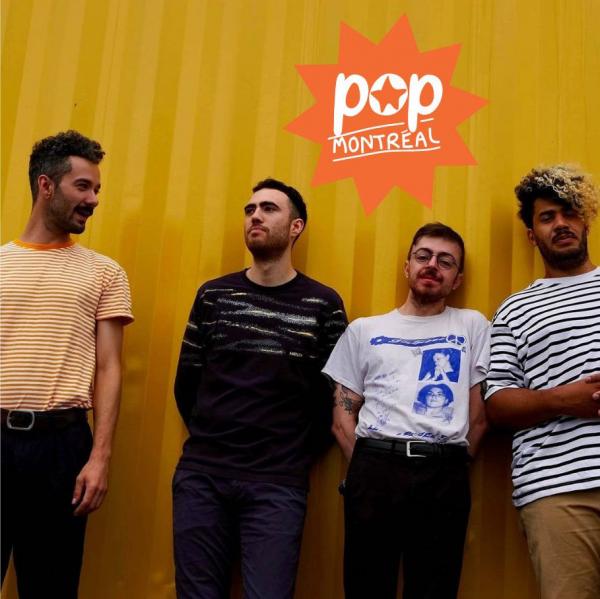
Upon first glance, the group appeared as an awkwardly odd jumble of millennial men, reminiscent of the leftovers of a graduate garage band. Singer and guitarist Joe Therriault is one of two front-men of the band, well-deserving of songwriting and light-speed guitar strumming credits. Main vocalist David Mitchell occupies middle- stage, and evokes intense emotion on his expressive face while bringing his artistic bass-playing abilities to the audience’s attention. Julien Daoust’s stunted emo-punk drum strokes recalled Travis Barker’s name to mind, both in his sleeve tattooed arms and in his musical style. Last, but certainly not least, the second main inspiration behind Gulfer’s groove: singer and guitarist Vincent Ford answers the infamous question: Where’s Waldo? Well, we’ve found him and he’s stage-left wearing a beanie; striped shirt and all.
With the clear clash of stylistic aesthetics, each artist seemed to exist with their instrument in their own universe, their wicked and wonderful melodic worlds colliding only over speaker-amplified tunes. The members' apparent individual differences also lended handily to weaving a fabric filled with diverse fibers of sound. Their collective melodic universe unveiled a wonderfully array of sweet-sounding songs sung by slick guitar riffs, just as quickly swept away into another dimension of heavy distortion and strained screaming.
Despite their lack of engagement with each other, they impressively energized almost all of the crowd to move in a jaunty and head banging fashion. The crowd happily clapped their hands and in a last effort to release every last bit of enthusiasm, pushed each other around in a polite but sweaty moshpit. Performing artists and audience members, equally tired from the long night of concerting, concluded the event in cheery applause in the wee hours of October 1.
Pop Montreal: 2022 Edition
It's the time of year again where the city’s heartbeat is a little more uptempo. The streets are plastered with pastel coloured posters with beautiful faces on them. Shops, restaurants and venue doors are left half-open despite the start of the autumn cold. And anyone you may bump into in the mile end area will be either coming from or going to one thing: Pop Montreal and Pop Montreal.
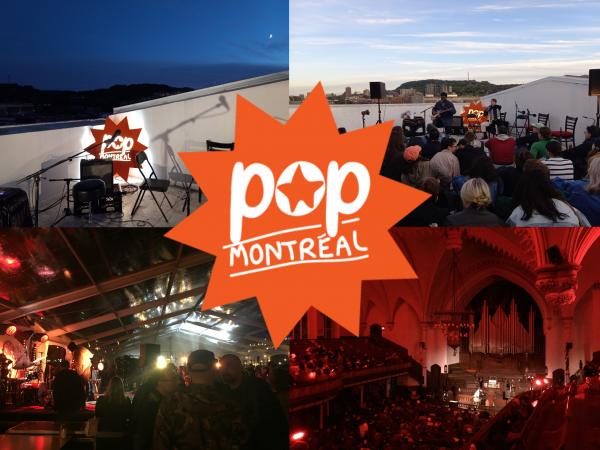
I was lucky enough to cover this year’s roster which featured some of the best names in upcoming artists. There were almost too many concerts to choose from, leaving one having to deductively pluck names from the never-ending lineup. Alongside the artists was the second attraction of the festival: the city. Festival goers would be lucky enough to see Montreal at its most beautiful; in its small venues, theatre rooftops, and makeshift stages. The locations, tossed across like dice, over the city map.
The opening night featured a celestial performance from legendary soul/funk band Cymande who played at L'entrepot 77, the perfect hipster venue in an old lot underneath the overpass on east Bernard. Cymande, a British band who were most prominent in the 1970s, found little mainstream success over the course of their career but were beloved amongst those who were in the know. The documentary Getting it Back, a retelling of their story played at Cinema Moderne just hours before their show, revving up audiences old and new, to see the band’s mythology become reality.
Another highlight of the festival was Cedric Noel’s rooftop performance at the Rialto Theater on Friday. The ultimate intimate performance; friends gathered together and sat down cross llegged to see the soft spoken indie artist. Between funny little anecdotes about trying (and failing) to call his mother on her birthday and him playing unfinished material, Noel removed all the grandeur of being a performer and made his audience feel at ease. The lull of his echoing guitar and careful voice were a perfect match for the just setting sun. Sitting there on the rooftop, you could watch everything around you slowly turn pink, see the bright singular light of the moon, or watch in almost slow motion as a plane crossed the sky.
Throughout the weekend, I managed to pop into a few other venues, most notably La Sala Rossa for Toronto based electronic artist Shn Shn who performed a flawless, ethereal set. But one of the most memorable moments of the festival was seeing experimental musicians FUJI|||||||||||TA (Yosuke Fujita) and Kali Malone perform at the St. James Cathedral on closing night.
Concert goers lined up down the street much before the show started, the excitement and the evening cold created a sense of urgency for everyone to quickly head inside. But when one finally scuttled through the venue doors, they would be stopped in their tracks at the sight of the nightime church all lit up in deep red.
Fujita was first to take to the stage. Based in Japan, Fujita performs with his handmade pipe organ and follows 7th century style landscape building music called “Gagaku.” His performance was utterly unique; balancing between natural and unnatural, organic and synthetic, life and when his piece was over, suddenly death.
Kali Malone, a sound artist based in Sweden was up next, this time performing on the cathedral’s organ. The red lights faded out and the church was left in almost total darkness. As Malone started her set, the towering golden organ pipes were suddenly illuminated and at their base sat her small silhouette in between two lanterns. When she hit the first reverberating notes, something half between a dream and reality began. The audience, captivated, sat still and silent in their pews.
In all, the festival whirled quickly through the city, feeling almost symbolic of the youthful spirit of Pop Montreal. This year’s edition featured art, music and creators as varied as never before. A definitive success, it left festival goers only wanting one thing: more.
Lisa Rupnik is ½ of the duo behind The Last Stop, a radio show dedicated to sharing conversation about music appreciation. Tune in Wednesday at 11:00AM to hear some of your old, new and forgotten favourites.
Festival de Musique Émergentes 2022
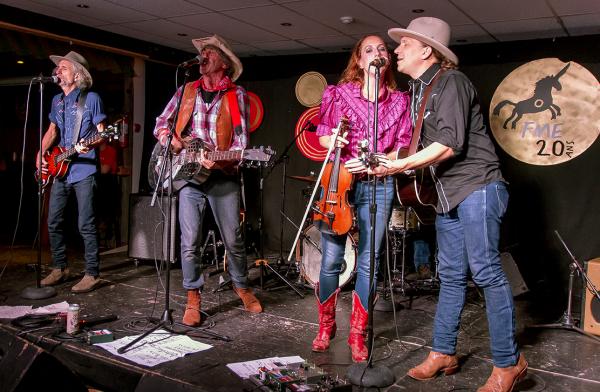
For the last few years prior to the pandemic I had been quite fortunate to attend FME, Festival de Musique Émergentes in Rouyn-Noranda. So much so that the festival is now something I always anticipate. So after a couple of years' absence and this being the 20th anniversary of the festival, I was particularly excited about heading up to this year's edition. The usual seven hour drive turned into an epic test of patience when every road ahead was traffic jammed. Luckily we had good tunes in hand and the promise of even greater adventures ahead to keep us going during the seven-hour-turned-nine-hour-drive to the festival.
After arriving and settling in, I had the opportunity to be part of the audience during the Paste Magazine live video recording of Johnny Pilgrim. A native of Valleyfield, Quebec where he was originally known as Jean Pellerin. In 1979 he left the province to seek his fortune in California. Armed with talent and a movie camera he became a much sought after videographer working with bands like Def Leppard, Guns N’ Roses and Metallica. Now his career has turned 360 degrees where he returns to his native province to sing the songs of Quebec’s native son, Tex Lecor. On his new EP, Sur la Trace De Tex Lecor he records six of Tex Lecor’s classic ballads like, “Grand Jos” and “Campangard.”
After finishing the Paste video Johnny Pilgrim headed over to the Diable Rond for a late night concert. Always humble, he often paid tribute to the roots of the French-Canadian songs he was playing. Recounting to the audience how that he grew up on the songs, hearing his mother sing along to them when he was four years old. Backed by a band of all-star players he educated the bar, and thanks to some outdoor speakers; the many happy passers-by on the history of Tex Lecor.
Balaklava Blues are a Toronto based ensemble started by Mark and Maricha Marczyk from the Lemon Bucket Orkestra. They combine traditional Ukrainian chants with techno multimedia performances. One of the few overtly political acts at the festival they put on a good show filled with political angst. A particularly moving moment was when they played their latest single, “Shelter Our Sky.”
Capping off the first day was the Brooklyn, New York band Gustaf. Comprised of Tine Hill on bass, Vram Kherlopian on guitar, Melissa Lucciola on drums, Tarra Thiessen on vocals and percussion and finally, Lydia Gammill on lead vocals. I found Gammill’s on stage style could best be likened to if David Byrne and Ian Curtis had a daughter. Often smacking herself on the side of the head while dancing in a stylish suit. She is contrasted by the often digitized singing and the cartoon-like Josie and the Pussycats dance style of Tarra Thiessen. Their show at Cabaret de las Derniers Chance lived up to all the hype that was buzzing amongst the press at the festival, billed as one of the up and coming bands not to miss. Their hour-long set was fun and filled with intent. They played the entirety of their 2021 debut album Audio Drag for Ego Slogs plus a few new songs, “Produce”, “What Do You Mean” and “Grounds.” Once again we have a video from the good folks at Paste.
With more outdoor stages it was hard to walk around the city without hearing music. In the FME preview article, I mentioned how the city gets involved. Not just garnishing store front windows with all things FME but I should mention the never ending work of the over four hundred volunteers that make the festival possible. After a fabulously long first day of the festival, Friday started slow and easy with pop artist Lucill from Chibougamau, Quebec. Songs like “Pour un Instant” showed a range of styles ranging from country, folk to classic rock and pop but their sound always came back to the easy listening vocals of frontman Raphaël Bussières.
It was indie band night at Petit Théâtre du Vieux Noranda and first up was ex-professional snowboarder Gus Englehorn. Joined by his partner Estée Preda on drums they performed songs from his first album Death & Transfiguration like, “You Broke My Collar Bone” and almost all of his latest 2022 release Dungeon Master. Englehorn's songs had a quirky, root for the underdog style that was always grounded by the perfect timing of his bandmate Estée Prada.
Next up was Tamar Aphek who grew up in Tel Aviv, Israel where she became a leading figure in the country’s underground music scene and helped organize one of Israel’s prominent music festivals, Indie Negev. Her concert at FME started off with an ambient almost drone-like sound but then slowly picked up momentum as the concert went on. Exploring her latest album, 2021’s All Bets Are Off, it sounded like a shoegaze band that got bored and decided to rock out, or as I like to say, “rockgaze.” Aphek calls her style "jazz & roll."
Closing out the evening was Calgary’s own Chad VanGaalen. With stripped down arrangements, just bass, drums and VanGaalen on guitar, songs like “Pine and Clover” lacked the slick production of his albums. Instead the songs had a much rawer, more aggressive sound. And yes, there's yet again another Paste video.
The most surprising and maybe the best show of Friday was the pop-up concert by Avalanche Kaito. A trio of musicians that combine African and western sounds that create, as it says in their bio, “an unruly and unforgettable sonic explosion.” The concert held in a parking lot, Stationnement Falco, was way too small to contain the effervescent singer, Kaito Winse. During extended instrumentals by his band mates Benjamin Chaval on drums and Nico Gitto on guitar, Winse would often leave the stage and engage with the audience. Constantly singing and/or dancing like a whirling dervish as if he was possessed by the music being played. Often he would run across and around the street helter-skelter spreading the positive vibes.
Closing out Friday with a late night early morning 1AM show by MMNQNS, pronounced mannequins. Vowels are so passé when you're a band that describes itself as a post-punk-power-pop-psych-synth-gaze-whatever band from Rouen, France. The wall of sound created by Gregoire Maainot on drums, Félix Ramaen on bass, Marc Lebreuilly on guitar and Adrian D’Epinay on vocals seemed to overpower the small stage at Cabaret de la Dernière Chance.The quartet stormed through their latest album, “The Second Principle” much to the delight of the audience.
The festival was kicking on all cylinders by Saturday, the third day of the festival. The massive rains of the morning had subsided leaving a chill in the air that reminded one that they are indeed far north and fall is not far off! But then Allô Fantôme took the stage and suddenly, the audience was transported back to a sunny afternoon in 1970’s Saint-Tropez. Allô Fantôme is the new project by Samuel Gendron that takes inspiration from 70’s extravagance with its rich arrangements and vintage style harmonies. The octet played the complete self-titled EP that was released this year and had the audience dancing to songs like “Sur la Pointe des Pieds” and “Allô Allô.” Allô Fantôme will also be playing at this year’s Pop Montreal Music Festival.
Later on in the evening pop and soul artists had their night at Petit Théâtre du Vieux Noranda. While not my usual fare of musical genres, it’s good to expand horizons as they say. R&B/Soul artist from Montreal, Fernie, led off with an inspired set channeling the likes of Billy Ocean and Daniel Caesar while showcasing his 2021 release, Aurora.
Next up was Lydia Képinski with her Las Vegas ready show. Képinski and her band belted out her latest album Depuis with all the lights, smoke and provocative dancing one would expect from the next big pop star.
Propelled by the critical success of his 2018 album La Nuit est un Panthère, Les Louanges is back with a new album, Crash, and after a quick break he took to the stage performing the new album to a rather appreciative audience that seemed to be enjoying themselves. But by that point I was all popped out and about ready to catch one of the bands I was most curious about: Growlers Choir. I didn’t have to travel far as they were playing across the street from the theater. I got there early as I wanted to be up front, but unfortunately my plan was foiled when we had to wait in the cold night air for forty-five minutes for the show to start. By that point I was less curious and more impatient to be wowed. I was not. They were definitely different, with sound check sounding like Dracula trying his luck at yodelling. I lost my spot up front when I got impatient and left to see if Animal Collective was still playing at the main outdoor stage, they were not. When I returned, the show had finally started. It was less operatic than I was hoping for and more like the name of the group implies, growls and grunts. Which was actually perfect for my mood as I was kicking myself for missing Animal Collective but the bit that I heard walking between shows which sounded quite good. Apparently I was not the only one to miss their show, apparently there was a rather low turnout. But then it was a pretty cold night with lots of great music to be had indoors. From what I was told they played a killer show with a mix of old songs like,“In The Flowers,” “The Purple Bottle,” “Bluish”, and “Chores.” Also on the setlists were some songs off their new album Time Skiffs.
After all my earlier frustration, Saturday ended on a high note when I caught an Atlanta based collective CDSM show at Hub Dejardins. CDSM or Celebrity Death Slot Machine put a funky smile on my face and those in attendance. The post punk disco rhythms of the band propel the lyrics which often deal with fame and or death. Such as in their song GFH or Gun For Hire, (they do like the initialisms): "she screamed / ”get out you f***ing narc, you f***ing creep!” / I tried to run but the knife hit my throat / and now I’m choking on my blood / like a pigeon in the mud."
One thing that FME is known for is the metal night that occurs on Sunday night, the final day of the festival. This year's lineup appeared quite promising with Abitabyss, First Fragment and Dying Fetus making up the head banging bill. But before that Ombiigizi was scheduled to play and they were another band that I did not know but was quite intrigued about. Ombiigizi pronounced om-Bee-ga-Zay meaning this is noisy is a collaboration between Zoon (Daniel Monkman) and Status/ Non Status (Adam Sturgeon). They are Anishnaabe artists who explore their culture through sound. I have to say the show was noisy and extremely guttreal. The band started to get their groove going on songs like “Birch Bark Paper Trails” from their latest album Sewn Back Together when much to my surprise, thirty minutes into the concert it abruptly ended.
With some extra time to kill I was able to enjoy one last quick walk around picturesque Rouyn-Noranda before heading over to the metal fest at Petit Théâtre. Local death metal stalwarts Abitabyss, who have been active for over fifteen years started the evening off with their energetic and welcoming show. The band proved that metal can be fun and lighthearted. Dressed in local hunting and mining attire they blistered through their latest album Rural Métal and some songs from the older albums Supremacy 08 and Requiem du Secteur Primaire.
The evening got much more serious when extreme neoclassical metal band from Longueuil Quebec, First Fragment took to the stage. Led by the manic guitar of Phil Tougas and the impeccable fretless bass work of Dominic Lapointe, the duo clearly liked showing off their technical prowess on songs like “Gloire Éternelle”; with its flamenco and technical metal stylings.
Closing out the night was Marlboro, Maryland’s own Dying Fetus. They played songs from their extensive catalog like “One shot, One Kill” from 2003’s Stop at Nothing and the title track from the critically acclaimed 2017 album Wrong One to F*** With. Even though the band is getting up there in age one just had to look at the goings on in the circle pit to know why they are still one of the better metal bands around.
The trio of bands carried on the FME tradition of celebrating metal. Which much to my surprise is what was played on the house speakers after the Dying Fetus concert. It was just too cool, metalheads singing and dancing along to Kool and the Gang.
All juiced up after three hours of head banging I headed over to check out CDSM who were closing out the festival with another late night show. The venue, a garage parking lot that happened to be next to the main stage where Hurbert Lenoir and his band were putting on a concert for the ages. Going around an hour and half longer than expected, Lenoir refused to let the party/concert end. I suppose he, like everybody else, just didn’t want to go home and they were having too much fun stage diving and sharing crackers and hummus with the audience.
While waiting patiently for the Hubert Lenoir concert to end, the members of CDSM were visibly excited about ending the festival, and wanted to do it on a high note. And that they did. Playing through their entire catalog of songs and providing some great jams along the way. It felt like those in attendance wanted the band to play till dawn and when they called out for an encore saxophone player Tyler Jundt said,“the only way the show could continue is if we had written more songs.”
And so ended the twentieth edition of FME. There were still a few diehards dancing the night away at the after-hour dj lounge. But for me it was time to stagger back to the hotel and get ready for the trip home where I will impatiently wait for the twenty-first edition of Festival de Musique Émergentes.
Dime's 2022 Glory Challenge

Montreal streetwear and skate brand, Dime brought their Glory Challenge back for its sixth edition last Saturday. Despite a two year gap due to the COVID-19 pandemic, their audience has continued to grow. Brand new challenges were being presented, and there was no shortage of skaters eager to conquer them. However, the goal isn't fame or fortune. “Getting together and having a community, that’s why I’m here,” said Leon Dechapdelaine, a skater hailing from Quebec, who was invited to the event.
While there are many other events that display skateboarding skills, Dime has always set themselves apart. “They see the importance of humor and creativity more than having goals or putting pressure on yourself,” said Dechapdelaine. Things like the free speed goggles given with each ticket, or the branded blimp that sat atop the bandstand displayed this. Despite this emphasis on humor, the competitors were prepared to push themselves to their limits, and the crowd was ready to watch them eat shit over and over. The excitement was evident as the raspy voices of the announcers asking the crowd: are you ready? The response was a resounding yes.
CHALLENGE 1: SPEED
In the first challenge, the objective was to land tricks while holding onto the speed from descending a 20 foot ramp. While Dime has held this challenge in the past, they added the element of tunnels for skaters to send their boards through while jumping overtop of them. This began with a 4 foot tunnel, but was extended to 8, 12, and 15 feet long, each paired with increasing speeds of Darude’s Sandstorm blasting from the speakers. Midway through the challenge, officials raised the ramp to 30 feet. One of the few challengers who rode it out was Krazy Franky, and it appears that he’s living up to his name. Near the challenge's end officials removed the plank, but skaters continued to shoot down from the higher platform. This provided a 10 foot gap which the skaters used to complete tricks mid-air.
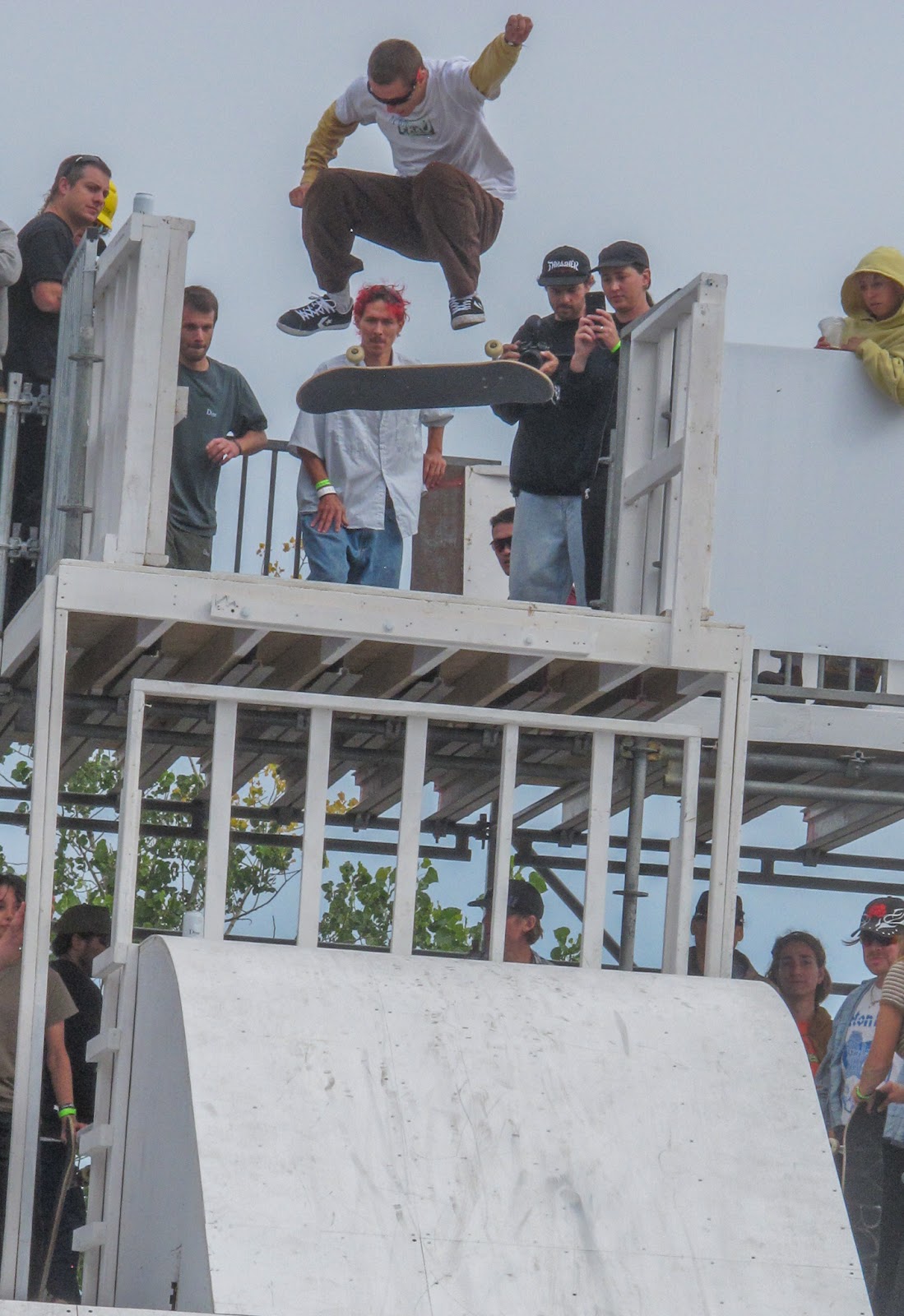
Krazie Franky dropping from the heightened platform
CHALLENGE 2: RAINBOW RAIL
A rainbow rail is exactly what it sounds like: a rail shaped like a rainbow. In this challenge competitors attempt to ride such a rail with the speed gained from the aforementioned 20 foot ramp. This seemed easy enough, as rails like this exist in many skateparks. The real difficulty would only slowly present itself. Five men outfitted with Dime safety helmets and overalls installed a second layer to the rail, increasing its height and length. This would repeat throughout the challenge, slowly but surely raising the stakes. The second and third layers were still within the realm of what one might see at a higher end skatepark, but the fourth is where it began to get a little bit dicey. Competitor Nicole Hause took a good few attempts before finally conquering it, only to have a fifth level installed immediately after. The growth stopped at 7 layers, giving it a total height of 10 feet and a length of 35 feet. Most attempts at riding it ended in willingful or accidental dismount, but skaters John Gardener and Roman Pabich saw it through.

Leon Dechapdelaine rides the penultimate level
CHALLENGE 3: BUMP TO BAR
After a 20 minute break, a large ramp with a metal bar at the top was brought out. Approaching it at high speeds gave riders a choice: to either jump over it or smack their shins and fly face first into the ground. Unsurprisingly, most went with the former. The first level was impressive, but not that impressive. Following the trend of escalation, a second level was added, giving riders a good six feet of air. The most unconventional use of the obstacles was Hugo Balek’s descent on rollerblades, the only use of them during the Glory Challenge. This event was more technically challenging for the skaters, due to most of them attempting tricks they wouldn’t land until a few tries in. This was exemplified by Chandler Burton's ridiculous dolphin flip, a trick which he had been going for all throughout the warmup. Burton also completed a nollie 360 on the third level of the ramp. The fourth level was about 7.5 feet tall, having to be assembled by forklift. Ryan Decenzo breezed through a frontside 360, while Chima Ferguson battled a backside 360. The 40 year old took 10 falls from 9 feet up before landing it to a roaring audience.

Chandler Burton’s dolphin flip
CHALLENGE 4: WORLD CHAMPIONSHIP GAME OF SKATE
The fourth event was restricted to two competitors as all games of skate are. The rules are as follows: person A sets a trick. If they succeed, person B has to attempt it. If they fail, person B sets a trick. If someone fails to land a trick while setting they only yield control, but failing while following gets a letter. The first letter would be S, followed by K, then A, and so on until someone gets all 5 letters. This year's matchup was X Games veteran Alexis Sablone versus Canadian underdog Breana Geering. They emerged from a fog dressed in boxer’s robes, stepped up to the center, and squared off in an arm wrestle to decide the first trick. Alexis, emerging victorious, set a kickflip. After matching this, Breanna completed a fakie kickflip. Alexis failed this, gaining an S. Geering then landed a nollie kickflip, which was completed by Sablone. Still in the lead, Geering set a switch pop shuvit, which Sablone failed to complete, adding a K. This concluded the first round. Sablone started round two with a switch kickflip, met with the same from Geering. Both failed their next sets but Sablone came back with a nollie heelflip, which got Geering her S. After both completed a heelflip Sablone put forward a fakie heelflip that Geering nearly stuck. This brought Geering’s K, and the end of round 2. Both missed tricks at the beginning of this round but Sablone put forward a fakie kickflip that Geering could not complete, giving her an A. Sablone refused to let up, completing a brutal frontside flip that Geering failed. Round 3 had ended and Breanna had all but one letter. The final round was finished in one trick. Sablone used her leeway to try a risky trick, a switch varial heel. Luckily for her, she succeeded. Breanna put forward her best attempt, but was unable to complete it. The game was over. Alexis Sablone remained on top.
CHALLENGE 5: ART SHOW
The next challenge was the art show. Large foam boards with shapes cut into them were held up for skaters to jump through. This was completed by jumping off a ramp and landing on an inflatable crash. While this event was probably the least technical, it exemplified the creative and humorous spirit which the fans came for. A few of the shapes were Roman warrior, Tony Hawk, a circle, and even Quebec itself. Not many people made it through without any breakage, but that only made those who did make it more impressive.
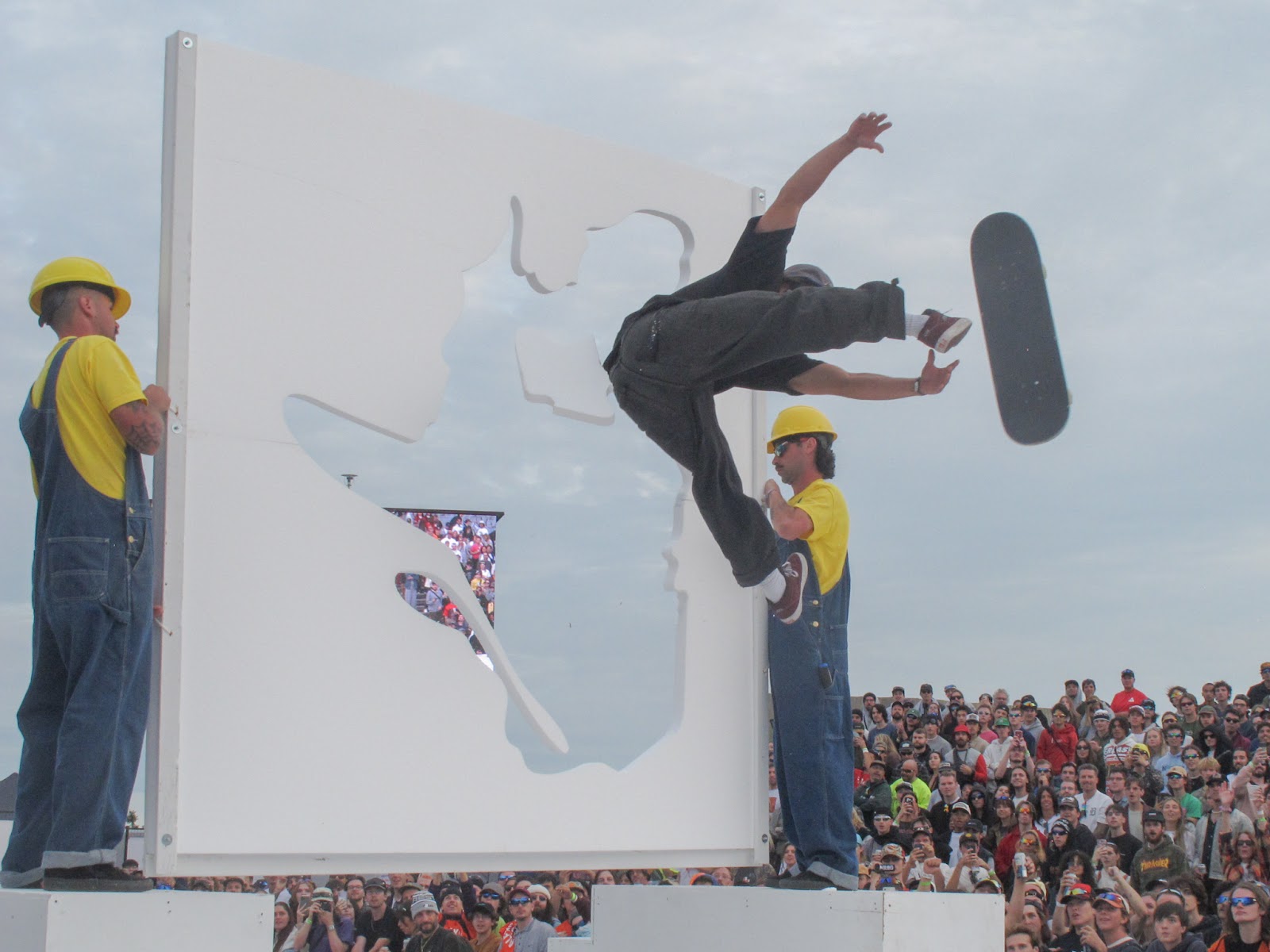
Pedro Delfino leaves Quebec intact
CHALLENGE 6: VOLCANO
The final challenge of the day was another repeat from previous years, but it was still improved on and escalated. Competitors would use speed from their descent to climb a 12 foot vertical ramp and perform tricks on the surface or rail at the top. One of the most notable examples was Pedro Delfino’s backside 360 which was met with plumes of fire and smoke erupting from the ramps peak. Soon after this the volcano rose to 20, and eventually 25 feet with the peak growing thinner and thinner. The bails - growing increasingly frequent, were met with Wilhelm screams and a terrifying fall, though no one was hurt. At one point the excitement was paused due to a spill at the volcano's base. Much care was put into its cleanup, a smart move considering the effects it could have if hit at a high speed. After a few more tricks and bails the volcano began to spew orange foam resembling lava. This forced skaters to stop, and after a few minutes of cheers and applause the crowd began to disperse.
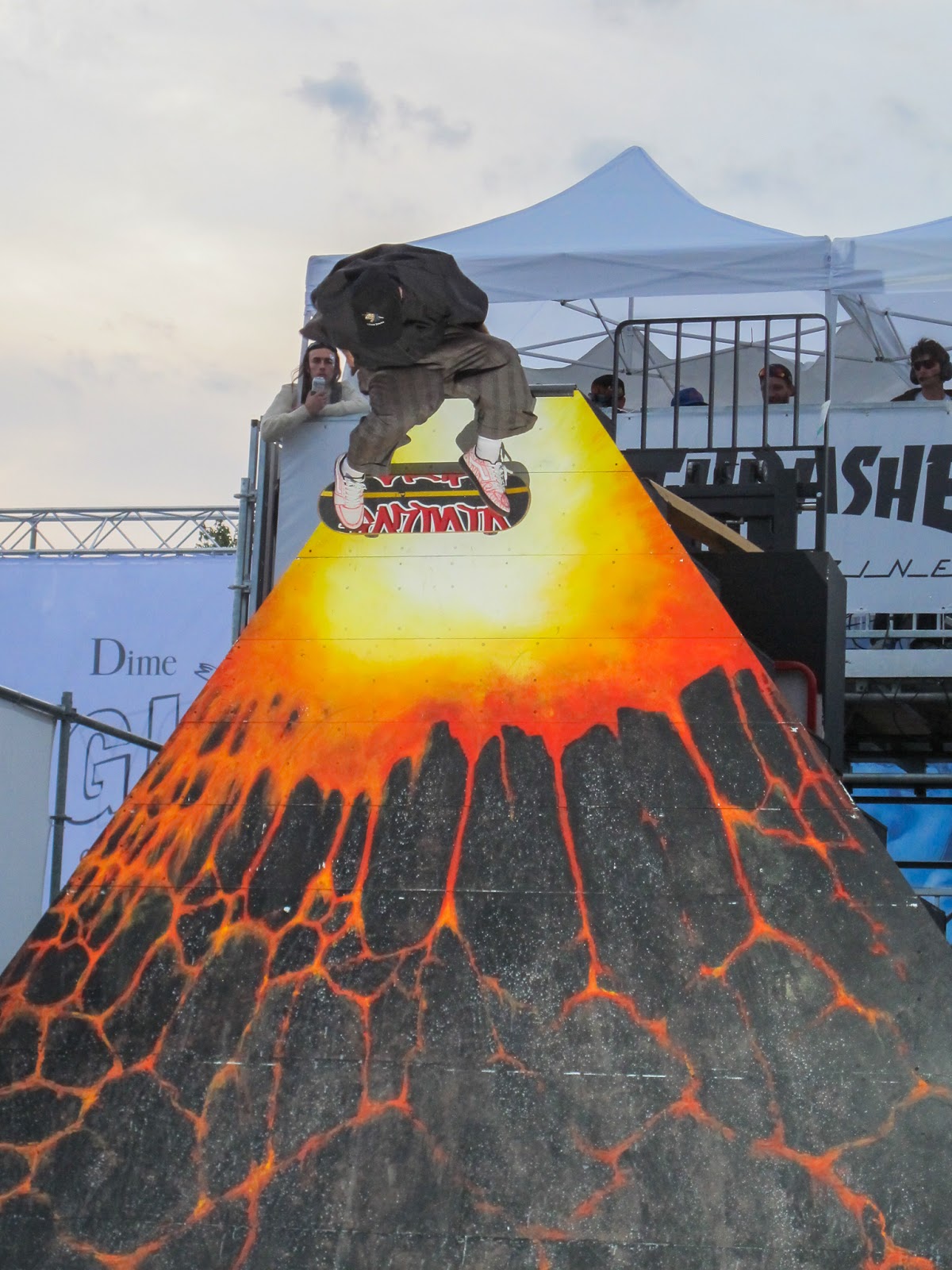
Pedro Barros climbs the volcano’s peak
CHALLENGE 7: HILL BOMB
The next day was a rainy one, creating some confusion as to whether the two outdoor events would proceed. Despite the Peace Park challenge being canceled, the Sherbrooke hill bomb went on. At the top sat a ramp followed by a 20 foot rail screwed into the asphalt. The crowd stood damp and expectant. Fewer people would be able to complete this challenge due to the conditions, but those who saw it through it were traveling at heightened speeds. Some even used the weather to their advantage such as Alexis Lacroix who slid the entire rail on his shoes, jumped onto his board mid air, and bombed down the remainder of the hill. Halfway through the rail was increased to 40 feet long making completion even more difficult. One of the few to succeed was Ryan Decenzo, nailing a 50-50 on his first try. Although many riders took huge spills which sent them sliding huge distances, they persevered and dominated the hill in the end.

Lacroix using weather to his advantage
Echo and the Bunnymen: 40 Years of Magical Songs
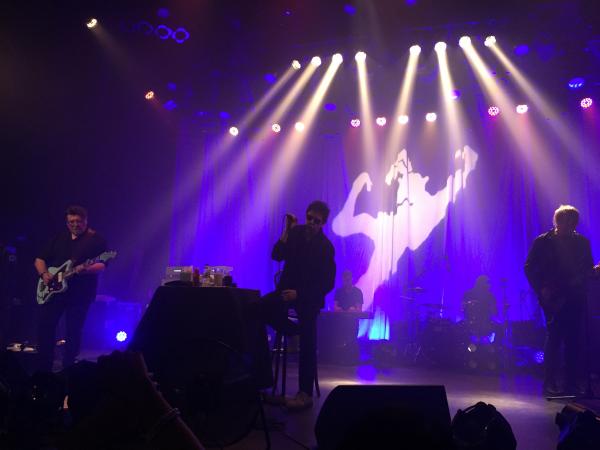
There was an electric undercurrent of excitement as fans shuffled into the Corona Theater last Monday night to see legendary post punk/new wave act, Echo and the Bunnymen. The band is currently on a tour of North America celebrating over 40 years since the band’s incarnation in Liverpool’s punk scene in the early 80s.
Among the crowd there was a mutual understanding that this concert was meant to be a celebration. Fans brought out their inner goth accordingly, by dressing in leather, Victorian-style frills and with spiked hair that seemed to go in every direction. Others sported black post-punk band t-shirts;, perhaps to quietly boast, or better yet, to revel in the crowd’s shared love for all things gloomy.
Right on time, the first act quickly and cautiously entered the stage.They were Bye Parula, a local act whose debut album is set to come out this January. They performed with an ecstatic enthusiasm that only an up-and-coming band could possess. In between songs, the lead singer explained how indebted he was to be performing with a legendary act such as the Bunnymen, as well as how he heard the news that his band would be opening: by receiving a phone call from lead singer Ian McCulloch while doing his laundry.
After the first act closed up shop, an impatient crowd watched as the roadies meticulously set up the next band’s gear. Yes, the usual standard stuff but this time with one eccentricity. Next to McCulloch’s microphone was a table with three glasses lined up neatly in a row containing whisky, beer and milk. The last item was the most peculiar, an unopened bear shaped jar of honey, sitting and ready for duty.
Once the lights went down and the crowd saw the first few silhouettes emerge from the fog, there was an almost religious exultation. The association of the image of Ian McCulloch and the Bunnymen are that of gritty black and white photographs from inner vinyl sleeves, film footage from foggy clubs and mysterious album art that depict figures as part of the larger, dark wonder of nature. Here they were now performing 40 years later, bringing the image of themselves to life while simultaneously keeping the fantasized narrative pulsing.
They opened with the chilling riff of “Going Up”, which couldn't had been a better start seeing as it's the first song off their debut album Crocodiles released in 1980. The set list was indulgent for fans, the majority of songs featured from their beloved early albums. The crowd, becoming an untrained choir, sang along to the band’s most popular songs with McCulloch playfully letting the crowd take over a few choruses. But when he did return to the mic, McCulloch’s vocals spindled and bounced, curved and dropped, as only a raw and masterful voice can. It was indeed a privilege to hear a vocalist who has such a short path from the voice to the soul.
Echo and the Bunnymen are continuing their tour across North America with a handful of east coast dates, all while enchanting audiences from city to city.
Perturbator & HEALTH @ Corona Theatre
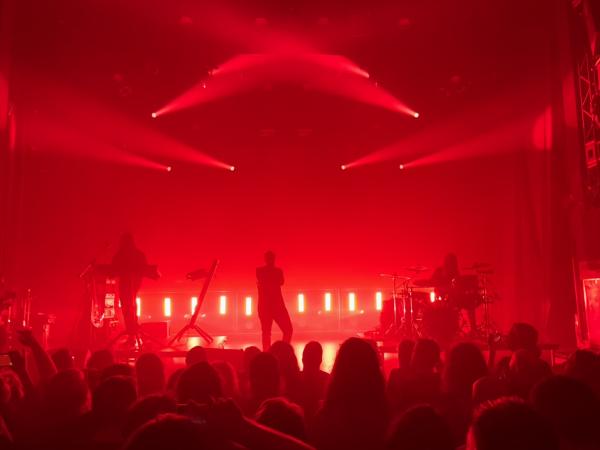
2022 has seen a lot of action for synthwave in Montreal. April saw Dance with the Dead rock Les Foufounes Électriques and just before that, Carpenter Brut having stormed through M-Telus. The double bill of Perturbator and HEALTH on September 8 brought another taste of the niche genre, this time at the Corona Theatre.
Except, labeling this concert as a synthwave show is a bit disingenuous. The noise/industrial act HEALTH has dabbled in the genre, but their eclectic catalogue is extremely varied. While Perturbator, a synthwave mainstay, has been subtly reworking his approach to the genre since the 2017 release, New Model. While synthwave is firmly entrenched in the neon gleam of gated drums and reverb-laden keyboards, this wasn’t a revisit to your favourite 80s movie soundtrack.
The context lies in HEALTH's recently released second chapter of their massive DISCO4 project, which heavily features other artists from a plethora of genres. To name a few: JPEGMAFIA, Xiu Xiu, Soccer Mommy, Lamb of God, etc. Two of these tracks were in collaboration with Perturbator. Another was made with special guests Street Sects.
Street Sects opened the night. The duo played a raucous brand of industrial music, somewhere nestled between Godflesh and Nine Inch Nails with a lot of hardcore punk mixed in. There was a lot to appreciate in their brutally honest set, with vocalist Leo Ashline screaming with utmost energy, jumping all around the stage, and Shaun Ringsmuth setting hectic rhythms with drum machines, synths, and samples. While I appreciated their short set, they did not garner much more than sensible praise from the crowd.
Eager for more, HEALTH finally took the stage. I'll admit I'm not well versed in their discography, having really only known them for their absurd skit on the Eric Andre Show (check it out here, it's hilarious). I did delve into the aforementioned DISCO4 and could only guess how these tracks would be played live. I was slightly disappointed in that regard, with most of the songs played coming from their previous releases. Despite that, HEALTH provides the appropriate bridge between the chaos Street Sects and the focused Perturbator. Their music often centralizes pulsating rhythms emanating from drummer BJ Miller, with vocalist/guitarist Jake Duzsik providing melancholic verses with his soft voice. The two are brought together through John Famiglietti, the group's wild card. This man works hard on-stage, seamlessly switching between the rhythm section on bass guitar, and then leading the music into sheer walls of noise while playing around with effects pedals. Set highlights included “CYBERPUNK 2.0.2.0”, one of their true synthwave tracks, and a rendition of “Tears” from the Max Payne 3 soundtrack. They were joined on stage by Leo Ashline of Street Sects for their duet, “The Joy of Sect”, and they ended their set with “EXCESS” featuring Perturbator, both tracks from DISCO4.
The final act came with Perturbator. The main man, James Kent, has been on a bit of a gothic streak, evident from his latest release, Lustful Sacraments. His attention was divided between his ever-present synthesizers and a first from him: guitar with a clean chorus-soaked tone. The guitar was a prominent feature of his recent record. This was augmented by a live drummer and a healthy amount of backing tracks. The set opened with his own “Excess”, the HEALTH track sharing the main guitar melody, albeit at different tempos. A large portion of the setlist consisted of other Sacraments, with the stage lights often sticking to oranges and yellows to match the mood of the album's artwork. When the colours changed to deep purples or bright aquas, we could expect hits from his previous albums, such as “Neo Tokyo”, “Future Club”, “Humans Are Such Easy Prey'' and a personal favourite, the crushingly heavy “Tactical Precision Disarray”. Seeing this futuristic style of music played at the century old Corona Theatre was oddly fitting, reminiscent of a scene from the original Blade Runner.
I left the venue totally satisfied with the night. HEALTH left a great impression on me, to the point where I've been binging their music ever since. It was my third time seeing Perturbator and it's always a great thing to experience. The tour moves on to the west coast and to Europe in October/November. Definitely don't miss this if you get the chance, or your next opportunities to see HEALTH or Perturbator.
And make sure to listen to Hooked on Sonics' interview with Jake from HEALTH here.
At the Gates at the Corona Theatre
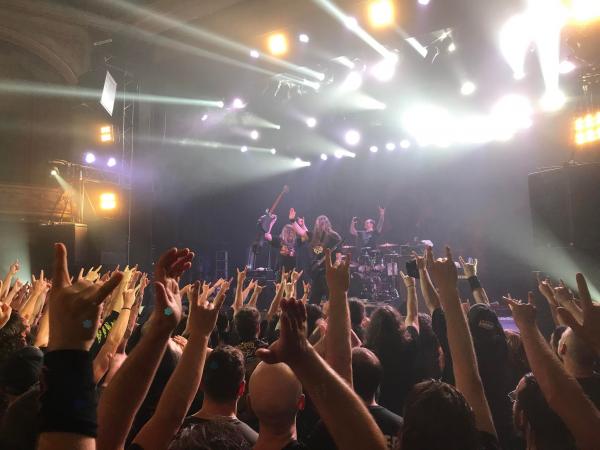
The At the Gates Slaughter of the Soul anniversary tour stopped in Montreal this past Friday. The seminal 1995 album turned 25 years old in 2020, and while the band was supposed to embark on a special tour that year to celebrate, virus-related delays resulted in the live dates getting postponed to this year. Thankfully At the Gates stayed true to their plans, touring the highly anticipated live set for North American audiences this year.
Although fans undoubtedly came for the headlining act, supporting acts Enforced and Municipal Waste made waiting for At the Gates a little bit easier. Sporting a broken arm supported in a sling, Enforced frontman Knox Colby commanded the stage with a lively performance, delivering his signature raw punk vocals to a packed Corona Theatre. Some of his instrumented counterparts could have done a little more than stand still while playing their guitars however, but the up-and-coming Richmond, Virginia crossover thrashers thankfully have an impressive catalogue of jumpy music to rely on which made for a good show.
Second opening act Municipal Waste may have stolen the night. Also from Richmond, Virginia, the crossover thrashers have been fan-favourites in the metal scene for over twenty years now, and for good reason. The energy in the room immediately went up a notch when the group took the stage, as the moshpit immediately doubled in size when the band’s chuggy thrashing onslaught began. And despite spending most of the night yelling into the microphone, frontman Tony Foresta was in a very welcoming mood, charismatically throwing smiles at the audience and engaging in fun banter between songs.
The group rifled through staple setlist tracks such as “You’re Cut Off,” “Sadistic Magician,” and “Breathe Grease.” During the anthemic “Wave of Death,” Foresta asked the audience to get as many people crowdsurfing as possible, and Montreal delivered. Boots and Converse were immediately flying through the air, as the frontman retrieved an empty recycling bin backstage and chucked it into the moshpit. Their set was a fun time.
Headlining act At the Gates finally took the stage, much to the crowd’s enjoyment. The Gothenburg legends played the entirety of the Slaughter of the Soul LP as promised, while also throwing other tracks into the mix, such as singles from their most recent record The Nightmare of Being, and 2018’s To Drink from the Night Itself.
In comparison to Enforced and Municipal Waste, who come from the same city and play the same style of music, At the Gates’ flavour of melodic death metal was quite refreshing to the ears. Still, their fast-paced yet sturdy songs got people bouncing around quite a bit, if not with a little help from the vibe-setting Municipal Waste prior. It was amazing to hear Slaughter of the Soul in its entirety, from mere melodic interludes to the heavy-hitting title track, which had the entire venue screaming along to the chorus. The group were also in top form, with original vocalist Tomas Lindberg bringing high energy alongside the other band members, one of which being live session guitarist Daniel Martinez, who also plays with technical death metal legends Atheist.
While there were no other complaints, an hour and a half of At the Gates’ music revealed how repetitive their material is. Although the group opened strong with their signature style, their tracks lacked variety, which created a lull towards the back half of their performance. Lindberg even hinted at the audience’s sapped energy, as he mockingly made a yawning gesture towards the crowd between vocal lines. To be fair, the waning energy may have been the result of the two high intensity openers.
Regardless, seeing At the Gates live, on top of hearing every song from the famous Slaughter of the Soul in-concert, was quite the treat. Although the tour has now concluded, please make sure to catch At the Gates, Municipal Waste, and/or Enforced the next chance you get.
Hunter co-hosts The Iron Club, your weekly guide to the dark and mysterious realm of underground metal, which airs every Sunday from 9:00 - 11:00 p.m.
What to expect at This Year's 20th Edition Festival Musique Emergence
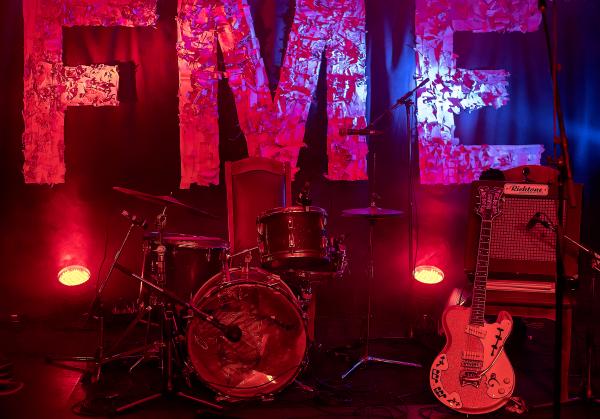
The 20th edition of Festival Musique Emergence (FME) is about to take off over the Labour Day weekend of 2022. For four days the northern Quebec city of Rouyn-Noranda in the Abitibi-Témiscamingue region of Quebec becomes a hub of all things cool. About a seven hour drive from Montreal, the festival aims to reduce travel. “People used to go to Montreal to see music,” says festival founder, Sandy Boutin, “and it’s a long journey, so we decided to bring musicians here.” Over the years, the festival has grown into a world renowned festival up there with the likes of Glastonbury, South by Southwest and even the Montreal Jazz Festival. Unlike other festivals that take place in a confined space, at FME the whole city gets involved. This is even more pronounced for the 20th anniversary edition, with the addition of a scenic route. A nostalgic scavenger hunt of sorts, artifacts made from scenography from past festivals can be found scattered across the city.
Thankfully after a two year break from COVID, the festival is once again welcoming international artists. With over 100 performances taking place across the city, from concert halls to surprise concerts in the local pizza parlour or to garage parking lots, FME is all about what’s going to happen; both in the sense of the emerging artists and the spontaneity of the festival itself.
After a quick review of the schedule, followig acts are only some of the concerts that should be noted. Thursday, the first day of the festival starts the festivities off with a bang. Bringing their Acadian rhythms to northern Quebec are New Brunswick’s own Les Hay Babies. Composed of Julie Aubé on banjo, Katrine Noël on ukulele and Vivianne Roy on guitar the trio mix old worlds and current motifs in their timeless songs. Hot off the heels of their third studio album, Boîte aux Lettres, Hey Les Babies are planning a newly crafted conceptual show, especially for FME.
Returning to the festival are the Medicine Singers, featuring New York City guitarist Yonatan Gat. This year’s lineup is privileged to include past members of the infamous no wave band Swans, Thor Harris and Christopher Pravdica and former DNA drummer Ikue Mori as well as trumpeter, Jaimie Branch.
Closing out Thursday—or starting Friday as early as midnight at the aptly named “Cabaret De La Dernière Chance,” is Brooklyn New York’s art punk band Gustaf; consisting of Tine Hill (bass), Vram Kherlopian (guitar), Melissa Lucciola (drums), Tarra Thiessen (vocals, percussion), and Lydia Gammill (lead vocals). In contrast to the Medicine Singers' long history, Gustaf only started their musical journey in 2018 when Tarra Thiessen met Lydai Gamill on their way to the South By SouthWest music festival.
Friday night festical-goers can catch The Tallies with Sarah Cogan on vocals and percussionist Cian O’Neille, laying down the rhythms. The Toronto based indie pop quintet will no doubt be playing tracks from their brand new second album, Patina.
And not to leave old school punk aficionados out in the lurch, Montreal band The Retail Simps and Newhaven Connecticut’s Killer Kin will be rockin’ the wee hours of the morning at Diable Rond. The Retail Simps feature the Pete Shelley-like vocals of Joe Chamandy and their album Reverberant Scratch: 9 Shots in the Dark is infused with the party punk vibe of the Buzzcocks. While Killer Kin is led by the screeching vocals of Mattie Lea, according to their bio the band plays,“ball-breaking, black leather sporting, soundtrack-to-your revenge songs.” This tandem of up and coming punk legends should provide a great late night smash fest.
One of the bigger names on the festival roster are experimental pop stalwarts, Animal Collective. Formed way back in 1999 in Baltimore, Maryland by Avey Tare (David Portner) on vocals and guitar, Panda Bear (Noah Lennox) on vocals and drums, Geologist (Brian Weitz) on electronics and Deakin (Josh Dibb) on guitar and synthesizer. That lineup is still together to this day and produced their latest sonic excursion, Time Skiffs in 2022, six years after the one before; Painting With. They will be performing their “bigger-than-life musical” Saturday night at the large outdoor stage, ScèneVidéotron. Along with opening acts Elizabete Balčus and CRi.
Fans of the psychedelic and or shoegaze genre should have their heads full with Solipsisme. This new project formed in 2021 by friends from Montreal and Quebec City consists of Francois Lemieux on vocals and Guitar, Maxime Doyer on vocals and bass, Samuel Gadreau on guitar, Taylor Fitzpatrick Johnson on acoustic guitar and synth and William Duguay Drouin on percussion. Since the band’s inception they have released a self-titled EP on the Folivora Records label.
Continuing the shoegaze vibe from Saturday, but with an added touch of angst, OMBIIGIZI plays at Diable Rond Sunday night. OMBIIGIZI pronounced om-BEE-ga-ZAY meaning "this is noisy" are Anishnaabe artists Zoon (Daniel Monkman ) and Status/Non-Status (Adam Sturgeon). Recorded during the summer of 2021 they released their first LP “Sewn Back Together” in February 2022. The album is a statement shaped by healing and the guidance of culture.
Quebecois sensation Hubert Lenoir will be playing the big outdoor stage Sunday night. Lenoir’s first album Darlène incorporated glam rock, psychedelic rock and chanson influences and was shortlisted for the 2018 Polaris Music Prize. In 2022 he won the SOCAN Songwriting Prize for his song, “Secret.” Also playing at ScèneVidéotron are Lou-Adriane Cassidy and Rich Aucoin.
A final night tradition at FME is the metal blowout at Petit Théâtre du Vieux Noranda. Past “nuit metal” included the likes of Swedish black metal gods Marduk and Italian symphonic death metal legends, Fleshgod Apocalypse. This year local death metal band Abitabyss are first to pick up the gauntlet. Together for fifteen years, they are currently working on their third album. Their first album Requiem du Secteur Primaire was released in 2004 and Rural Métal, in 2014. Next up is extreme neoclassical metal outfit from Quebec, First Fragment. Based around the virtuoso musicianship of Phil Tougas on guitar and Dominic Lapointe on fretless bass and the guttural vocals of David AB. After a hiatus from the road the band is currently on an extended tour to promote their latest album that was released in 2021, Gloire Éternelle. Closing out the night of imploding ear drums are American death metal icons, Dying Fetus. Getting their start in 1991 in Marlboro, Maryland the band has had many lineup changes over the years but the one constant is lead singer and guitarist John Gallagher. Filling out the power trio are Sean Beasley on bass and vocals and Trey Williams on drums. One can look for plenty of new songs as their ninth album is set to be released later this year.
If aural strangeness is your bag, look no further than Atlanta collective CDSM, who will be playing a late night show at Garage Rheault. CDSM, short for Celebrity Death Slot Machine, includes current and former members of various Atlanta alternative bands with Tyler Jundt leading the way on synth, saxophone and lead vocals. In April of 2022, the band released its first EP, Hell Stairs.
After three days and nights of musical mayhem one might need to slow down and center their chi. To help achieve this state of bliss is Acadian singer, songwriter Julie Doiron. Known for her time with the indie band Eric’s Trip for which she was a founding member back in the ‘90’s. Recently she released the album I Thought of You, her first since 2012’s So Many Days.
Scheduled for midnight Sunday Montreal surf punk band No Wave has the weight of closing out the festival fall upon their shoulders. This young, emerging band includes Angel Parra Vela on guitar and vocals, Cyril Harvin Musngi on bass, Sam Sussman on drums and vocals and Jean-Michel Coutu on keyboards. They released their first self-titled EP in 2019.
All the aforementioned concerts are just some of the artists at the festival, a mere tip of the iceberg. For instance Montreal hip-hop artist Naya Ali will be making a return visit and folk artist Johnny Pilgrim will be performing multiple times throughout the weekend. And then there are the surprise pop up concerts that FME is so famous for. All in all, the 20th edition of FME is ready to once again show the world that a small city in rural Quebec can host one of the best music festivals around.
August in Blue: The Blues in Maggie Nelson’s Bluets
While August in Blue seeks to celebrate the Afro-American contribution of blues music, the genre week that today comes to its close, also encourages us to reflect on the overall role the blues plays in our lives even when we’re not listening to the blues. To have the blues, is in part, to experience the blues music. The blues can be found everywhere, especially in literature. And we owe it to blues musicians for furthering the ethos of ‘having the blues’ beyond music.
So, suppose you could write 240 mini love letters. Who would you address them to—what would you address them to? For writer Maggie Nelson, it was the color blue. In the 2009 experimental Bluets, Nelson melds memoir, poetry and philosophy and essay writing in attempts to transcend the signage of language by finding ways to discover what the color blue means to her, all while detailing her affinity for blue without any of the clichés of having the blues. As Nelson does so, she also grieves the loss of a lover.
Nelson obviously is not the first person to write about having the blues. Our notion of Melancholia as a self-reflexive state of being aware of our sadness and choose to continue wallowing within it as an “art” that heightens one’s appreciation for life comes from the late 19th century Romantics. But even before poet John Keats wrote of Melancholy as a “wakeful anguish of the soul” and before William Wordsworth poeticized the bucolic vales “overflowing with the sound” of a nightingale’s “melancholy strain”, Melancholy was considered by the Ancient Greeks as one of the body’s Four Humours; the four bodily liquids that determined a person’s well-being. When a person was Melancholic, it meant that there was an excess of black bile in the spleen, and so the notion of treating any emotion under a clinical microscope formed how civilizations to come would rationalize feelings.
Take Robert Burton’s The Anatomy of Melancholy for instance. In 1621, Burton publishes the first edition of the medical treatise addressing Melancholy (and what would be in many hundreds of years later, Nick Cave’s favorite book), in over 900 pages that explored what he believed was the nature, symptoms and causes of Melancholy (which to him we’re God, witches, and devils among other external forces), potential cures such as dieting and cleanses, as well as distinguishing between religious Melancholy and love Melancholy. And as history goes, women’s feelings of sadness or depression were always dismissed as delirium. But in The Anatomy of Melancholy, Burton also furthers the sexist trope of connecting a women’s melancholy to being sexually deprived whereas a man’s melancholy is continually associated with intellect—for instance, take the Romantic poet Lord Byron who is revered for being a brooding figure. In The Anatomy, Burton proposes that women ought to domesticate “those vicious vapours which come from menstrous blood” through marriage, under a chapter title that I’ll let speak for itself: “Maids', Nuns' and Widows' Melancholy.”
Nelson’s Bluets, however, is unapologetic. Most of her memories she recounts in the book are memories of “the fucking” between her and her former lover. Within the context of herstory and when Nelson writes “there is a color inside of the fucking, but it is not blue”, she subverts the sexism that’s pronounced in The Anatomy and the notion of associating Melancholy to sexuality as a whole; demonstrating how her blues are instead associated to trauma, by subsuming the color to the loss of her former lover who she coins as “the prince of blue.” Nelson also juxtaposes the visceral experience of feeling vs. the palpable experience of sight between her heartbreak and love for the color blue with her close friend who has become quadriplegic. What arises as a result, is a tension between what can and cannot be expressed about emotion, which blue intensifies for Nelson.
With the loss present in Nelson’s life, from the pains of heartbreak prompted from the ‘prince of blue’ and her close friend’s life-altering disability, my favorite moments from the book happen to be the ones that meditate on her consequential loneliness and nostalgia. One of the book’s themes is grappling with solitude, yet Bluets is anything but isolating with the writing stylistically reminiscent of a written letter; which perhaps is Nelson’s way of garnering closeness, even if it’s in the hands of some reader. This calls to mind when in Letters to Milena, Franz Kafka suggests, “writing letters is actually an intercourse with ghosts”, and Bluets' epistolary-like writing style also points to another realization Nelson must come to terms with: that writing to the prince of blue, and of the memories is to speak to an ideal that may never have been fully present.
It becomes apparent to readers that Nelson’s book of all things blue, is actually one of letting go, “for just because one loves blue does not mean that one wants to spend one’s life in a world made of it”; a reality fraught from nostalgia’s allure. She calls to mind an instance where Leonard Cohen, in an interview, admits that “he could no longer remember the specifics of the love triangle that the song ['Famous Blue Raincoat'] describes.” To which Nelson confesses, she “find[s] this forgetting quite heartening and quite tragic . . . for to wish to forget how much you loved someone- and then, to actually forget- can feel, at times, like the slaughter of a beautiful bird who chose, by nothing short of grace, to make a habitat of your heart.” Notions of the passing of time and the ephemeral come to the forefront without ever being directly addressed, but the heaviness lingers between the lines; the weight being left to sympathise with anybody who has experienced heartbreak and the torture of memory.
Pages



Staff Login | Advertise | Our Location | RSS | Contact Us
