RSS
The 2010 HARD Tour feat. Crystal Castles/Rusko/Sinden/Destructo

My friends and I walked into Metropolis a few minutes after 8 p.m. just as the show was starting, at least according to the timeslots I’d found online, which later proved to be all kinds of inaccurate. We got there a lot earlier than planned so I was a little unenthusiastic mostly due to the fact that: A) this is Montreal where the party doesn’t get going ‘till 11 p.m., B) this was a Sunday night, surely not the busiest night of the week and C) Destructo, the opening DJ and only artist on the line-up I didn’t know was going to be playing ‘till 9 p.m. (I’m a little jaded and by default never expect much from opening DJs). I figured I was going to be in for a long hour of monotonous electro beats and watching the crowd slowly trickle in as a dozen diehards tried to get the dance floor started. Suffice it to say I was in for a surprise. There must have been 1,000 people there already and not a single one shared my opinion of what a dance floor is supposed to look like at 8 p.m. on a Sunday night. The place was absolutely going off. That’ll teach me to be a cynic.
After I got over the shock of seeing the crowd and actually started to take in the whole set up I was suitably impressed. I’ve been to other DJ shows at Metropolis before and the stage set up is never anything to write home about: lights, table, banner of some kind, DJ. It was clear that HARD had some stricter expectations. The DJ booth looked great, it was raised behind a long LED screen that primarily displayed whoever happened to DJ, peppered with various visual effects and images. Certainly made the whole show appear more professional than most I’ve gone to in the past. There were a few visible but as of yet unused LED towers behind the DJ on the stage and a standard Metropolis lighting rig above the crowd as well.
It was becoming clear that I’d severely underestimated this event and that this night was going to be full of surprises. Destructo was one of them. There’s something that needs to be kept in mind about this show before going forward: it wasn’t necessarily a Crystal Castles tour, it was the HARD Summer Tour 2010 with Crystal Castles headlining; emphasis on HARD. Destructo is the man behind the HARD Tour and the festival that takes place every year in L.A. He definitely played accordingly. His sound consisted mainly of heavy electro bangers with a particular focus on big buildups and drops. The bass was so intense that he literally had the whole building shaking, the TVs bolted to the walls looked like they were about ready to fall off. He did an excellent job of getting both the crowd and I worked up and ready to party.
Sinden hopped on a few minutes after 9, a little delayed due to some technical difficulties getting set up. He toned down the heaviness a little bit and added a bit of dub and dancehall flair. Which isn’t to say that the atmosphere of the party suffered at all for it; the first few crowd surfers started popping up during this hour. His set reminded me a lot of a Major Lazer set actually. In fact he dropped at least one Major Lazer track and a few regular staples from Major Lazer sets ("Manges [Sharkslayer Dub]" by Digital Manges and "Underground Sound" by Seductive; if you don’t know them check them out). His sound wasn’t as focused on big drops as it was on percussive sounds and building a solid groove. It’s around this time that I realized this was an all-ages show, there was a group of at least five 12-year-olds really rocking out right next to us. I’m used to the drunken, messy hipster crowd these shows normally draw in so this was definitely a little bit of a shocker to me.
When Rusko came on at 10 p.m. things really started to get crazy. I knew he was the biggest face leading the current mainstream tip of dubstep that’s blowing up right now but I guess I hadn’t realized how big he’s gotten. The second he even stepped onto the stage, during Sinden’s set mind you, the crowd exploded. Everyone started screaming, beer started getting thrown all over the place and I overheard a bunch of people around us start yelling “It’s him!” and “This is going to be crazy!” Frankly I was a little disappointed with his set. I prefer my dubstep dark and aggressive whereas his definitely took on a lighter, almost poppy tone. He played a lot of tracks with melodic female vocals and some straight up pop remixes, as well as classics everyone would recognize like a remix of “Day ‘n Night” by Kid Cudi and “Where’s My Money” by Caspa. While his basslines were undoubtedly heavy they eventually got a little monotonous. He’s carved himself such a niche that eventually it all just sounded the same. That being said the people on the dance floor still lost it; despite my complaints it’s clear that his sound has found a wide and dedicated fan base. It definitely wasn’t for everyone though. A lot of people went up on the balcony to see refuge from the near mosh pit the dance floor had become, me included. I was a little confused by the combination of Rusko and Crystal Castles when I first heard about the show and while it definitely worked for the majority there was still a portion of the crowd upstairs with very clear “WTF is this?” looks on their faces. His set ended around 11:15.
It took 25 minutes for the stage crew to clear out the DJ booth and set up Crystal Castles' drum set and keyboards. They had set up the stage so that the LED towers surrounded Crystal Castles in a semi-circle pattern and in between each set of towers were some strobes. I normally wouldn’t bother explaining what the stage set-up looked like but theirs played a big roll in their show. They’re definitely a band that is very aware of their image and the set-up was designed to compliment that. When they did come on all of Metropolis went dark except for those LED towers or strobes, which would take turns lighting the venue with basically seizure-inducing flashes. I’m not sure the lights ever stayed on consistently for more than 1 second at a time. It created a very chaotic, violent atmosphere that worked exceptionally well with their presence and sound.
The other effect was that the band members were little more than silhouettes on stage because the lighting was all behind them. Maybe this wasn’t the case for those down in the pit as I was still on the balcony for this but I’m almost certain it had to look the same everywhere. It was particularly cool and off-putting at times when it came to Alice, their vocalist. She never stops moving, ever. The whole time she’s jumping or bouncing around, flailing her whole body, throwing herself on the ground or into the crowd. During their more melodic songs like “Empathy” the fact that she was just a silhouette made her body seem very disassociated from her voice. I couldn’t make sense of how someone moving so violently and chaotically could sound so calm. I almost wanted to be able to see her lips just so I could understand it. It gave the whole thing a ghostly kind of ethereal feel that I really enjoyed. As performers they were excellent. The raw, lo-fi feel of their music sounded even better in a live setting and despite all the filters she sings through it’s easy to tell Alice has an absolutely beautiful voice.
Like everything else about them their set was pretty abrupt. Around 12:20 or so as soon as they’d hit the last note on one of their songs (I didn’t have the foresight to note which one) the lights came on and without a word they all got up and walked right off stage. It was so quick that I wasn’t even sure what was happening. Then the lights went off and they back on just as quickly. I figured out later that this was their encore but at the time I wasn’t even sure. My friends and I left 10 minutes after and I founded out that they were done a few minutes after that. All told their set clocked in around 50 minutes long. It might have been short but considering how energetic and relentless it was I can’t say I blame them.
While Crystal Castles may have been the act I was least familiar with going into the show they definitely impressed me the most. I look forward to seeing them again in the future and really recommend you do to if you get the chance.
-Patrick Meloche
News August 23rd 2010
Read and produced by Lachlan Fletcher.
Stories written by Chris Hanna and Nicholas Fiscina.
Canada's Arctic Claims
In 2009 the New York Times called the fight over Arctic territorial claims, The biggest land grab since colonial times, and said it was accelerating as nations scramble to claim writ over hundreds of thousands of square miles of ocean floor, much of it believed to be rich in natural resources.
Determining who controls the Arctic Ocean's seabed won't play out until a few years from now. Russia has decided to postpone its Arctic bid to 2013 while Denmark and Canada have until 2012 and 2013, respectively, to file claims of which Canada's are well supported by maritime law. Norway became the first nation to win control of Arctic territory, when the commission finished its review of Oslo's claims north of Svalbard, a region that lies far south of the North Pole. This leaves Russia, Canada, Denmark and the US to sort out the remainder of the Arctic riches.
What has all the maneuvering been about? The U.S.G.S. (US Geological Survey) has also run an assessment of undiscovered oil and natural gas reserves in the region and concluded that the continental shelves are a veritable treasure trove. Specifically, according to U.S.G.S. estimates, hidden within the continental shelves lies between 22 and 256 billion barrels of oil and as much as 2,990 trillion cubic feet of natural gas. These numbers are significant. The mean estimate of undiscovered oil reserves is more than double the amount of oil that has been previously found in the Arctic. Also, the median estimate of undiscovered natural gas in the Arctic represents about 30% of the world’s undiscovered reserves.
And there is the Northwest Passage. One day, the fastest way between Asia and Europe will be across the Arctic Ocean from the Bering Strait in the West to Baffin Bay and the Davis Strait in the East. There are a number of possible routes but the quickest and most likely to be ice-free for extended periods of time are those that traverse through Canada’s Arctic islands. The savings in time and cost will be enormous. For example, travel time from Japan to the Netherlands would be cut in half. Moreover, ships travelling through the Northwest Passage will not be limited to the maximum size currently permitted through the Panama Canal, the so called Panamax Ships.
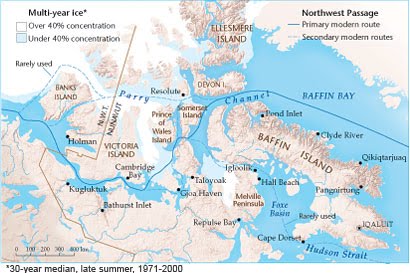 When will the Northwest Passage will be fully navigable? Likely sooner than anyone thinks. In September 2007, the European Space Agency used a series of satellite photos to establish that an ice-free route through the Northwest Passage existed for the first time in modern history.
Now, after years of promises about standing up for Canada's claims to Arctic, the Conservative government has decided it wants swift and permanent solutions to issues that they have heretofore preferred to leave unresolved. Canada will make finding solutions to Arctic boundary disputes this country’s top foreign-policy priority in the far north. The reason being, one can assume, is that Canada is the most vulnerable of all the nations involved in the disputes to a potential loss of control over its Arctic waters -- this due to a lack of appropriate ships, port facilities and infrastructure to enforce the existing laws and regs.
Shelagh Grant of the Globe and Mail asserts, Canada no longer has the luxury to dither and debate. If this government fails to take immediate action, Stephen Harper may well go down in history as the prime minister responsible for the nation’s loss of control over its Arctic waters – as will the Canadian people for allowing it to happen.
Pakistan - New Media and Politics
In Pakistan, fully one fifth of the country is said to be under water and the floods have not just devastated the lives of millions of people, they now present an unparalleled national security challenge for the country, the region and the international community. Lest anyone under-estimate the scale of the disaster, all four of Pakistan's wars with India combined did not cause such damage.
And there are a myriad of other problems that have been created: Millions of acres of crops have been destroyed and villages washed away. Joblessness and helplessness will lead to more young men joining the militants ...and the floods have not stopped the rampant violence in the country. The Pakistani Taliban continue to carry out suicide bombings and assassinations and have vowed to wipe out the Awami National Party which governs KP province. The Taliban are now threatening to prevent Pakistani non-governmental organisations from carrying out relief work.
There's also the scourge of water-bourne diseases and the risk of an epidemic:
If you want to help:
http://shelterbox.org/
https://secure.oxfamamerica.org/...
http://www.unhcr.org/...
https://secure.unicefusa.org/...
https://secure.my-websites.org/...
http://plan-international.org/...
https://www.internationalmedicalcorp...
https://secure.ga3.org/...
http://www.unicefusa.org/...
https://www.donate.bt.com/...
https://donate.doctorswithoutborders...
Omar Khadr's Trial By Military Commission
Back in January of this year, the Supreme Court of Canada ruled that the constitutional rights of the young man from Toronto, protected by the Canadian Charter of Rights and Freedoms, had been violated, but the same court turned down orders from lower Canadian courts to have the Conservative government of Stephen Harper request the return of Khadr to face justice in a Canadian court system. The Harper government was effusive in its' praise of the ruling: Canadian justice minister Rob Nicholson hailed the Supreme Court's ruling, reiterating his government's line that "Omar Khadr faces very serious charges including murder, attempted murder, conspiracy, material support for terrorism, and spying."
There are international laws concerning child soldiers and there are good reasons for them to exist. Obama's administration is engaging in the first prosecutions for war-crimes by a minor since WWII.
Glenn Greenwald asks the question that has never been fully explored in the Canadian news media: how can it possibly be that the U.S. invades a foreign country, and then when people in that country -- such as Khadr -- fight back against the invading army, by attacking purely military targets via a purely military act (throwing a grenade at a solider, who was part of a unit ironically using an abandoned Soviet runway as its outpost), they become "war criminals," or even Terrorists, who must be shipped halfway around the world, systematically abused, repeatedly declared to be one of "the worst of the worst," and then held in a cage for almost a full decade (one third of his life and counting)?
The facts of the case, the circumstances of his capture, how he came to be there and what has been done to him during, what must be for him, eight very long years. Khadr, then 15 years old, was taken to Bagram near death, after being shot twice in the back, blinded by shrapnel, and buried in rubble from a bomb blast. He was interrogated within hours, while sedated and handcuffed to a stretcher. He was threatened with gang rape and death if he didn't cooperate with interrogators. He was hooded and chained with his arms suspended in a cage-like cell, and his primary interrogator was later court-martialed for detainee abuse leading to the death of a detainee. On top of everything else, he was also subjected to severe sleep deprivation for a period of three weeks.
Maher Arar who was held and tortured by the Americans for nine months, says that the express purpose of the military commission: to convict.
Stephen Harper and his government have fought any and all attempts to repatriate this Canadian citizen.
The trial has been suspended temporarily while defence lawyer Lt.-Col. Jon Jackson convalesces. Jackson, who had gall bladder surgery six weeks ago, was to be airlifted to a U.S. medical facility after collapsing in court.
UPDATE:
The military judge presiding over Omar Khadr's war-crimes case has ruled today that there is no credible evidence that he was tortured by his American captors or interrogators.
The testimony given by Khadr’s primary interrogator nicknamed "the monster" for the three months the teenager was detained at Bagram, before his transfer to Guantánamo in October 2002 is at odds with the judge's ruling: Referred to only as “Interrogator One,” he said he interrogated Khadr about 20-25 times, more than anyone else, totaling about 50-100 hours of interrogation. He added that he first interrogated Khadr when the 15-year-old was sedated and lying handcuffed on a stretcher, about two weeks after he was brought to Bagram with multiple gunshot and shrapnel wounds.
In 2005, Interrogator One pled guilty to prisoner abuse at Bagram, in connection with the death of a detainee two months after Khadr was transferred to Guantánamo. He was convicted of forcing a detainee to roll around on the ground and kiss interrogators' boots. He also pled guilty to twisting the bottom of a hood around another prisoner’s neck and forcing him to drink a bottle of water, causing him to gag and choke. He was sentenced to five months' imprisonment.
At the hearing for Khadr, ...Interrogator One replied, “I don’t specifically recall” to most of the defense’s questions about abuse he may have inflicted on Khadr.
Jennifer Turner of the ACLU, an observer to the testimony says of what she saw, ...that his (Interrogator number one) evasiveness and fading memory probably thwarted a full accounting of Khadr’s treatment at Bagram. The chances of Omar Khadr receiving a fair trial see diminished.
CJLO Presents SUPERCHUNK + Kurt Vile & The Violators + Little Scream September 23rd at Le National
BUY YOUR SUPERCHUNK TICKETS HERE!

Doors 7:00, Show 8:00
$23.50 Regular, $10 for Concordia Students, First 50 people with a CJLO t-shirt get in for FREE!
http://www.superchunk.com/
http://www.myspace.com/kurtvileofphilly
http://www.littlescream.com/
Tickets on sale August 23rd via National box office, CJLO offices (email manager at cjlo dot com for appointment), l'Oblique, Cheap Thrills, Sound Central and Atom Heart. Only regular tickets will be sold via Admission. Tickets will also be available during Orientation on September 15th, 16th and 20th in the Hall Building Mezzanine at the Kiosk between 12pm and 5pm.
Valid Concordia ID required at point of purchase and at the venue at entry on day of show for student tickets. Anyone without valid ID at the show will be asked to pay the balance of the ticket cost at the box office.
Special thanks to our sponsors: Montreal Mirror and Blue Skies Turn Black!
CJLO Presents Disorientation 2010
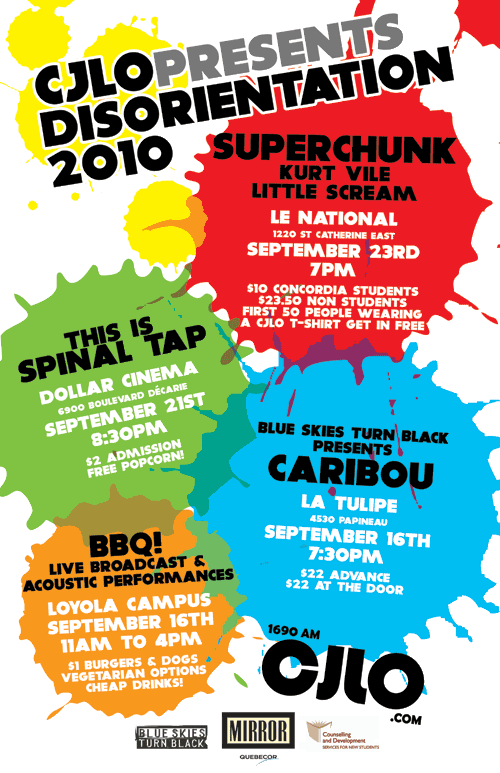
CJLO presents the very first edition of Disorientation! A series of very special events that students and non-students alike can participate in to make that fall grind a little less painful and a little more fun!
Thursday, September 16th:
11am-4pm
BBQ and Live Broadcast with local artists performing at the Loyola Campus. Cheap beer brought to you by the CSU, cheap food brought to you by us, veggie stuff available. Just $1 for all food and non-beer items and tunes by CJLO DJs. Thanks to the Concordia University New Student Program!
8pm:
Blue Skies Turn Black & CJLO Present CARIBOU live at Le National (1220 Ste Catherine E). For more info visit the BSTB website.
September 21st:
Screening of THIS IS SPINAL TAP at the Dollar Cinema (6900 Decarie). $2 entry, free popcorn. 8:30 show time.
September 23rd: SUPERCHUNK!
SUPERCHUNK + Kurt Vile & The Violators + Little Scream
September 23rd at Le National (1220 Ste Catherine E)
Doors 7:00, Show 8:00
$23.50 Regular, $10 for Concordia Students, First 50 people with a CJLO t-shirt get in for FREE!
Tickets on sale August 23rd via National box office, CJLO offices (email manager at cjlo dot com for appointment), l'Oblique, Cheap Thrills, Sound Central and Atom Heart. Only regular tickets will be sold via Admission. Tickets will also be available during Orientation on September 15th, 16th and 20th in the Hall Building Mezzanine at the Kiosk to the side of Java U between 12pm and 5pm.
Valid Concordia ID required at point of purchase and at the venue at entry on day of show for student tickets. Anyone without valid ID at the show will be asked to pay the balance of the ticket cost at the box office.
Special thanks to our sponsors: Montreal Mirror and Blue Skies Turn Black!
CJLO will also be DJing at all CSU events during Orientation, so come on down and get your chance at one of those coveted t-shirts.
More info to come, keep it locked to CJLO 1690 AM or online at www.cjlo.com or on iTunes Radio.
News August 20th 2010
Read and produced by Nicholas Fiscina.
Stories written by Alina Gotcherian, Chris Hanna and Candace Roscoe.
The Under-reported War
There are days you can sift through your local Canadian fish-wrap and not know that there are Canadians at war on the other side of the planet. When you realize that Canada has been in Afghanistan longer than they were in the European theatre in WWII and no one can as of yet readily define what victory will look like -- you have to ask yourself why our forces remained there for such a long stay.
At the very least Canada's media could engage in more than just perfunctory coverage. I took a look through today's Montreal Gazette and found two items on Afghanistan - one a short article on Afghanistan's President, Hamid Karzai seeking help in the fight against insurgents from Russian President Dmitry Medvedev. And the other an even shorter piece, on an issue that should be of concern, about security fears shutting down more than 900 polling centres before Afghanistan's parliamentary elections next month. There is mention of the upcoming election being a litmus test and that it will be against a backdrop of increasing violence as the Taliban-led insurgency has spread out of the traditional strongholds in the south into the rest of the country. That is not a sign of progress -- are Canadians aware?
So let's take a look at the under-reported news from just this last week. The above mentioned increase in violence is undermining the hope that Karzai can deliver security and a legitimate government. The US is expecting heavy fighting around the key Afghan city of Kandahar through this fall, one Pentagon official said Wednesday, dimming hopes for big gains in the war ahead of U.S. elections and a White House review of its war strategy. And so the US military is apparently urging Barack Obama to slow down the withdrawal of troops from Afghanistan, which was planned to start next year.
General Petreus, the commander of U.S. forces in Afghanistan said in an interview, "The timetable of U.S. troops' withdrawal from Afghanistan will be driven by situation on the ground," providing a ready-made excuse for not leaving next year. With unsettling reports like the following from the Washington Post: With most Afghan and NATO troops stationed in the country's south and east, villagers in the path of the Taliban advance into the once-peaceful north say they are powerless and terrified, confused by the government's inability to prevail -- and ready to side with the insurgents to save their own lives -- how can anyone believe that they'll be able to declare victory and withdraw like they've just done in Iraq? Keep in mind the Iraq withdrawal involves leaving 50,000 troops behind.
In fact, General Petraeus has stated his belief that the July 2011 drawdown date, set by President Obama in December and quietly disavowed by virtually everyone in his administration, was not something that would bind him either. So even though the US Defence Secretary, Robert Gates has put himself at odds with the country's top commander in Afghanistan by ruling out any delay in the start of troop withdrawals next year, who are you going to believe? Where's the analysis in the MSM?
It's a very complex situation that in all likelihood won't be resolved by next year -- Four members of the House of Representatives held talks last month in Europe with leaders of Afghanistan's ethnic minorities opposed to President Hamid Karzai and his U.S.-backed initiative to open political negotiations with the Taliban. There was acknowledgement by Dana Rohrabacher, R-Calif., after the meeting about the nature of the problems faced: "None of the people of Afghanistan except for the crooks at the top are interested in a central government with all the power," Rohrabacher said in a telephone interview last week. "That's the model that we have been trying to force with our military ... on the people of Afghanistan." And that that widespread corruption has not been dealt with in a timely fashion in spite of repeated warnings from the Americans to Karzai to clean it up.
Karzai has declared that he wants to do away with the 52 security firms, both foreign and domestic operating in Afghanistan. They employ more than 24,000 guards who work mostly for Western entities. Karzai, who calls the independent fighting forces "thieves by day, terrorists by night," has set a four-month timeline to dissolve the companies and bring their workload under his government's control. That may not sound like a terrible idea but in the unstable environment that currently exists the fear is ...transit routes will be impassable, foreign companies will leave Afghanistan, the economy will suffer, and -- perhaps most ominously -- unemployed security guards will turn to the insurgency.
Lastly, some numbers that should give everyone pause and deserved scrutiny from the media, in less than two years the US has suffered more combat deaths in Afghanistan under President Barack Obama than it did during the two-term presidency of George W. Bush.
That's just a week of cherry picked news from Afghanistan and it didn't include this week's civilian deaths or the protests over same. None of this augers well for our Canadian troops who are there until July of next year.
Pigeon Hole Phoner w/ Rhuk One on Da Cypha

Rhuk One, host of former CJLO Hip Hop show extraordinaire Scarborough Sessions has returned to the air and his first assignment; interview the one and only Pigeon Hole. When the opportunity to interview both Dusty & Marmalade of Pigeon Hole came about, Doc Holidae couldn't do it, but he got the next best thing (some would say the best option but that’s a different discussion). Even though The boys have been busy touring with Sweatshop Union promoting their recently released album Age Like Astronauts (# 2 CJLO Hip Hop Charts and # 12 on CJLO Top 30), they took time talk life and music with Rhuk One.
Tune in Friday August 20th for the triumphant return of Rhuk One to the airwaves and an interview not to be missed…
P.S. Yes Döc Holidæ is secretly trying to convince Rhuk One to start a show and no, he is not ashamed to ask on the frontpage of the CJLO website.
Want more Rhuk One, follow him on twitter @TERMtl
Pages



Staff Login | Advertise | Our Location | RSS | Contact Us
