RSS
Preview: Shiva Baby from Director Emma Seligman, a Pitting Comedy
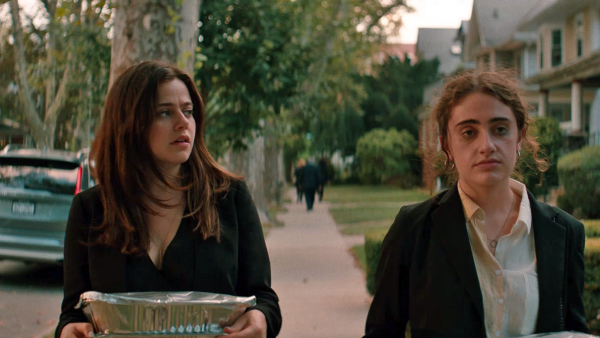
Shiva Baby from director Emma Seligman can be best described as a dark comedy in the similar vein to the cult comedy Death at a Funeral. After meeting her soon-to-be sugar daddy Max (Danny Deferrari), college graduate Danielle (Rachel Sennott) rushes to meet her neurotic parents for a family shiva. Danielle is confronted by relatives who question her lack of ambitious post-college dreams while her ex-girlfriend Maya (Molly Gordon) is applauded by the family and relatives for getting into law school. The day doesn’t seem to end when Max shows up to the shiva alongside his wife Kim (Dianna Agron) and a crying baby. Danielle must keep up appearances with different versions of herself, fend off family pressure, and confront her own insecurities.
After making a successful run at both SXSW and the TIFF festival circuit, Shiva Baby will be releasing in select theatres where open, and streaming services where available as of April 2. Cinéma Moderne in Montreal will also be hosting a screening.
Remi and Danny host At The Movies, which can be heard every Tuesday morning from 8:00 - 9:00AM. Tune in for discussions about movies, soundtracks, and iconic film scores. At The Movies also covers film festivals that are located in Montreal.
Preview: New Film Like a House on Fire from Montreal director Jesse Noah Klein

Like a House on Fire is a new film from Montreal director Jesse Noah Klein, starring Sarah Sutherland (Veep) and Quebec singer Hubert Lenoir. Dara (Sarah Sutherland) returns home after a two year absence to connect with her husband and her daughter. However, things are not what they seem. There is a new woman in the household who is seven months pregnant with Dara’s husband’s baby and her daughter does not seem to recognize her anymore. The film then becomes a story of a woman’s struggle to regain control of her old life.
Coming off the success of this past Toronto International Film Festival Like a House on Fire is currently playing at Cinema du Parc - a great way to support your local independent movie theatre.
Remi and Danny host At The Movies, which can be heard every Tuesday morning from 8:00 - 9:00AM. Tune in for discussions about movies, soundtracks, and iconic film scores. At The Movies also covers film festivals that are located in Montreal.
The Holy Trinity: Songs Named After Albums Named After Bands

Cover Photo Credit: Rolling Stones
If you listen to the radio enough, you’ll eventually hear something similar to the following, declared by a radio host who thinks they’re clever, perhaps while even hiding a smirk. “This is the song “Motörhead” off Motörhead by the band Motörhead!”
The phenomenon we’ll be discussing today is something I personally dub the “Holy Trinity,” an instance in a band’s discography where a song is named after an album, which is named after the band. A self-titled number on a band’s self-titled album, if you will.
While this odd musical occurrence isn’t exclusive to metal music (songs like “(Theme From) The Monkees” (1966), “Kool & The Gang” (1970), “Bad Company” (1974) are notable non-metal “self-titled” on the self-titled examples), the metal genre has an interesting relationship with the inclusion. A large number of the genre’s founding bands deferred to the “Holy Trinity” on early landmark albums within the genre, carving their name in metal music’s opening explosion.
The group who started this trend was, fittingly, the group who invented metal. “Black Sabbath” opens Black Sabbath’s debut self-titled 1970 album, a song that produced out of a nightmare bassist Geezer Butler had after borrowing a tome of black magic from vocalist Ozzy Osbourne. Apparently originally impromptu lyrics, Ozzy’s somber opening utterance “What is this that stands before me?” is the introduction to heavy music for many. Apart from the legacy that still surrounds the song over 50 years later, “Black Sabbath” is extra special, given that it was named after the 1963 horror film of the same name. So it’s actually a song named after an album named after a band named after a movie.
The phenomenon spread as fast as metal music did. “Motörhead” opens Motörhead’s 1977 self-titled debut, interestingly a cover of a Hawkwind track, vocalist Lemmy Kilmister’s prior band. The song itself represents the energy of metal music, as comparing Motörhead’s blaring 1977 version to proto-space rock band Hawkwind’s 1975 version is like pitting a rabid rottweiler against a frog. Lemmy also added the umlaut to the song title of Motörhead’s version, further metal-izing the track (thanks, Mötley Crüe).
Iron Maiden also closed their infamous 1980 self-titled declaration with “Iron Maiden,” an anthem track for the band and for metal music in general, with lyrics like “Iron Maiden's gonna get you, no matter how far.” The same thing can be said for NWOBHM titans Angel Witch, who opened their self-titled debut from the same year with a self-titled number. “Angel Witch” less-so defines the band, and rather helped to kickstart the genre’s borderline embarrassingly overdone fascination with witch imagery. Other notable examples of self-titled “Holy Trinity” tracks released on influential metal self-titled debut releases are “Saint Vitus” (1984), “Metal Church” (1984), “Carnivore” (1985), “Overkill” (1985), “Deicide” (1990), “Iced Earth” (1990), and “Electric Wizard” (1994). These songs/albums/bands are all landmarks within the development of metal music.
This collection of songs is notable because they all stem from the formative years of the aforementioned groups, who all largely influenced their respective scenes at the time. Of course, these tracks were open declarations of a new music movement, with many becoming fan favourites as the years passed. Songs like “Deicide” and “Iced Earth” tie back to a time before things like fame, fat cheques from record labels, and artistic stagnancy would go on to plague every band named so far. These songs were whipped up by angsty kids, unknowingly writing music history that would define them forever.
Looking closer at the very handle I’ve been using for these tracks paints an even broader picture. Please excuse the religious reference for a notoriously anti-religious genre, but much like the Christian Holy Trinity, these songs represent the mind, body, and soul of the artists that wrote them. Self-titleds like “Black Sabbath” and “Iron Maiden” come from the minds of young artists, actualizing their newfound creative visions. The tracks themselves are the body, the tangible life-blood entities that come together to create what we call music. They represent the spirit of the artistic medium, with bands singing about the meaning of metal itself, or adding much-needed punk energy to old tracks, creating something entirely new with pure aggression and noise.
The “Holy Trinity” is also infinite and unkillable in essence. When Black Sabbath opened their last ever concert in 2017 with “Black Sabbath,” the song didn’t die. It will forever remain in the hearts of the societal outcasts who call themselves metalheads, among landmark numbers like “Motörhead” and “Saint Vitus,” with new generations discovering these sonic declarations to this day. New bands continue to wave the flag, with notable tracks like “Skeleton” (2020), “Kvlt of Odium” (2020), and “Deer Lord” (2020) marking a new wave of “Holy Trinity” tracks from smaller artists carving their own names in the living flesh of metal music. Some of those names aren’t as catchy, though.
Hunter co-hosts The Iron Club, your weekly guide to the dark and mysterious realm of underground metal, which airs every Sunday from 9:00 - 11:00PM.
Supreme Court rules on carbon tax, Petition regarding Alberta’s coal mining expansion, Fourth COVID-19 variant in Montreal
Hadassah Alencar
________________________________________________________________
Supreme Court rules Ottawa’s carbon tax constitutional
The Supreme court decided Ottawa can hammer down a carbon tax on the provinces.
Even though Conservatives couldn’t agree on this, the court said the climate crisis is a real and serious threat.
Ottawa has already prepared a minimum carbon pricing outline that’s ready for the provinces.
If the provinces refuse to tack on those fees, Ottawa can do it for them.
Canadians can expect to pay these fees along with industrial companies.
Petition to have Ottawa intervene in Alberta’s coal mining plans
In other news, over 18,000 Canadians are urging Ottawa to intervene on Alberta’s plans to expand coal mines.
The popular petition was on the parliamentary website for almost a month, and was launched in collaboration with Indigenous water protectors.
They’re asking that Alberta consult with First Nations regarding coal mining projects, due to the severe environmental impacts coal mines have on the land.
Fourth COVID-19 variant in Montreal
Montreal has a fourth variant of COVID-19 which was first recorded in Nigeria.
Only two Montrealers are known to have contracted this variant so far.
The city has identified a total of 704 known cases of COVID-19 variants.
Metal My Movie: Notions of Metal Sound through sound design in Sound of Metal

Before They Were Heavy: Surprising Starts in Metal Music
A lot of legendary hard rock and heavy metal performers had their start in decidedly un-heavy bands. Especially for musicians who came of age when The Beatles rose to fame, boppin' in a '60s boy band was a surprisingly common first taste of musical fame. Here are a few heavy icons who had surprisingly easy-listening starts... and a couple of easy-listening icons who started off surprisingly loud!
Ian "Lemmy" Kilmister
Lemmy, like many rockers of his era, namechecked The Beatles and Little Richard as his earliest influences. Though there are no shades of the speedfreak gravelpit sound he'd helm for 40 years, in 1966 he was slinging his bass for The Rockin' Vickers on this toe tapper, "Dandy":
Ronnie James Dio
Before he became a heavy metal Dio (Italian for "god"), Ronnie James Padavona had more in common with another Italian American crooner, Dion, singing sweet songs with his group. Initially known as The Vegas Kings, then Ronnie and the Rumblers, and eventually Ronnie and the Red Caps, you'll get a cavity from their 1961 track, "An Angel is Missing":
Bon Scott
The original, and still mourned, lead singer of AC/DC seemed surprised by the screaming girls as he provided backup harmonies on this cover of "Build Me Up Buttercup" performed by his Perth, Australia boy band The Valentines in 1969:
Alice Cooper
Before he was Alice, teenaged Vincent Furnier once competed in his high school talent show as a member of The Earwigs, a Beatles parody band. That band eventually became The Spiders, a respectable garage rock outfit, as evidenced on this 1966 track called "Don't Blow Your Mind":
Iggy Pop
Speaking of talent shows, this punk progenitor got his start drumming in a garage rock band created for that same purpose. The Iguanas had a mild amount of fame in Iggy's home state of Michigan, but he soon went on to much heavier things. Check out his 1965 cover of Bo Diddley's "Mona" here:
Trent Reznor
Though you can hear the faintest shades of what was to come, there's something disconcerting about seeing Trent Reznor's mid-80s New Romantic hairdo bounce in time to his early band. Leaning into that trendy synthpop sound, this is a 1985 TV report on Exotic Birds:
Billy Joel
Before becoming your granddad's favourite, the Piano Man was in a proggy psych metal duo called Attila. Things were peachy until Joel ran away with his collaborator's wife, but we still have this 1970 self-titled record to remind us of what could have been:
Michael Bolton
Michael Bolton wasn't always makeout music for the adult contemporary set. In fact, he used to be a hard rock singer, and opened for Ozzy on tour. Here he is, hair in full effect, on "Everybody's Crazy" from 1985, before his sound took a different direction:
Have any other secret heavy metal starts to share, or any other non-metal "before they were famous" tidbits you know about? Share with @CJLO1690AM on Facebook or Twitter!
At The Movies Race to the Oscars (Audio) Review: Promising Young Woman
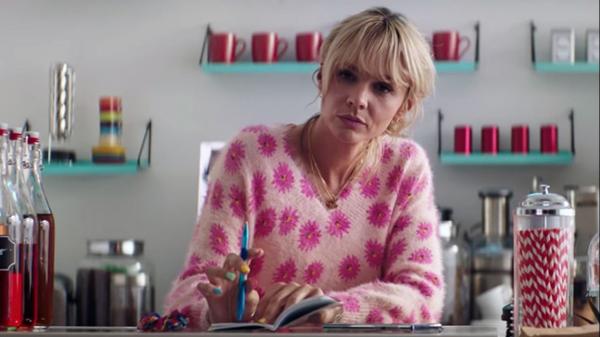
The following film being reviewed deals with mature subject matter like sexual assault and viewer discretion is strongly advised before viewing.
ASIAN LIVES MATTER, ANTI LOCKDOWN PROTEST, LEGAULT CALLS NEW FIRST NATIONS TABLE A ‘BIG STEP FORWARD’
Reporter: Shanellie Marie
Stories: Luca Caruso Moro
ASIAN LIVES MATTER
People gathered in downtown Montreal Sunday to call attention to what many have called
a rise in anti-Asian racism since the beginning of the pandemic.
After the march, a vigil was held for the eight people who were killed in massage parlours in the Atlanta area on March 16.
Most of the victims were Asian women.
The man allegedly responsible for the shootings has been charged with right counts of murder.
ANTI LOCKDOWN PROTEST
The day before, hundreds of protests took place around the world against COVID-19 lockdown measures.
In Montreal, hundreds marched downtown against the curfew and other health restrictions.
While it’s legal for people to gather to protest, attendants are still supposed to maintain distancing when possible and wear a mask.
Montreal police handed out 52 tickets to people violating health measures, for approximately 1,550 dollars each.
LEGAULT CALLS NEW FIRST NATIONS TABLE A ‘BIG STEP FORWARD’
Finally, Indigenous leaders in Quebec and the provincial government announced a new plan to address the needs of First Nations and Inuit communities Sunday.
They say chiefs from communities across the province will establish priority topics
to be looked at over several meetings, which started this weekend.
Several others have been planned, including one on economic recovery in the fall.
In a Sunday press release, the premier said he believed, quote, “we are taking a big step forward.”
Metal My Movie: Guardians of The Galaxy

A message from CJLO 1690AM Management and the CBSC on the CSU Elections
CJLO 1690AM is proud to support Concordia students during this uncertain time through volunteer opportunities, diverse programming, paid positions, and podcast funding. We believe that Brick by Brick, led by Eduardo Malorni, is the right team to lead the Concordia Student Union through this unprecedented period of change. It is clear that Eduardo, S Shivaane, Malcolm, Hannah, Faye, Camina, Aria, and Harrison are best-equipped to help students navigate the upcoming school year. As a media organization, we prioritize open communication, transparency, and accountability. We are happy to see Brick by Brick lay out plans for direct and ongoing dialogue with the Concordia student community
In 2020, we have initiated two projects with the Concordia Student Union, alongside Eduardo, as Student Life Coordinator. First, we worked with the CSU executive on developing a podcast series about the latest news and issues affecting the Concordia undergraduate student community. This podcast is called The Yellow Curtain and is available on CJLO’s SoundCloud account. Second, we worked with the CSU to create a Podcast Development Fund available to undergraduate students looking to go above and beyond with a special audio project pertaining to Concordia students. We are proud to work with Eduardo on these projects and we hope they continue into next year and beyond.
As a fee-levy group, we understand how important it is to serve students and give them a meaningful, enriching campus experience, and how instrumental the CSU is to fostering and nurturing that experience alongside groups like ours. We would like to continue serving students and expand on our growth in 2020, with a student-focused CSU as our partner, so that we can continue to report on the news, deliver content, and curate music that students need and expect during this time.
If you are a Concordia undergraduate student, please show your support for Brick by Brick on March 16 to 19.
Sincerely,
CJLO 1690AM Management
Concordia Student Broadcasting Corporation
Pages



Staff Login | Advertise | Our Location | RSS | Contact Us
